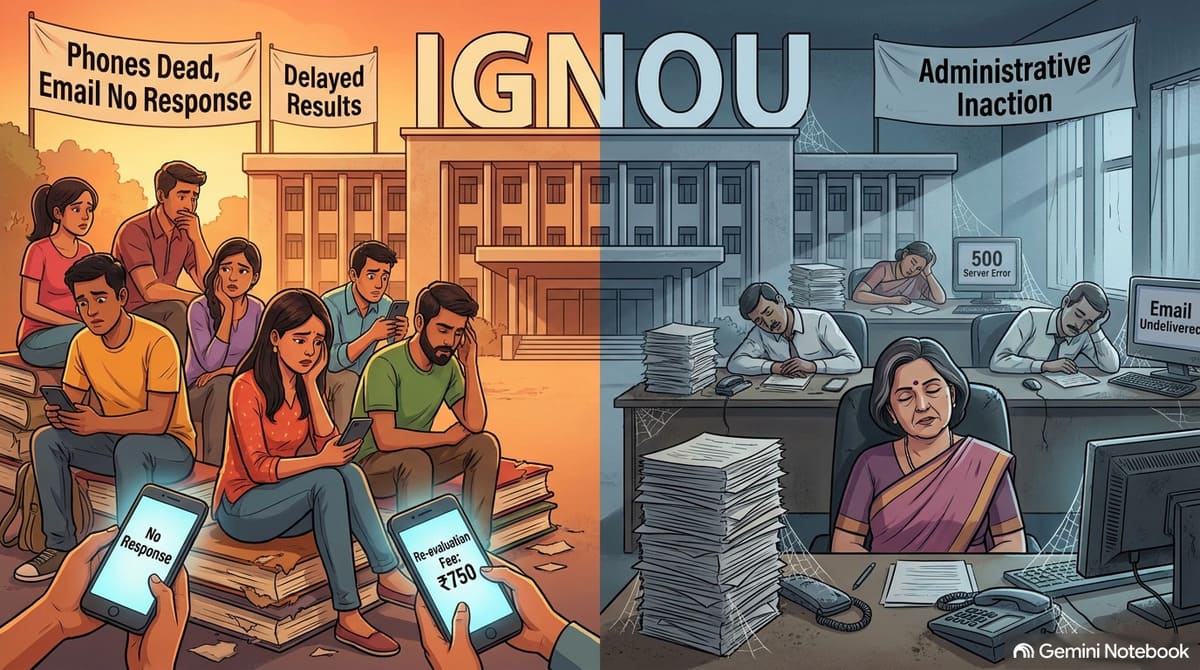
IGNOU Vice Chancellor Prof. Uma Kanjilal’s Inaction Towards Reform Amounts to an Attack on Students’ Fundamental Education Rights
Indira Gandhi National Open University Vice Chancellor Prof. Uma Kanjilal’s complete refusal to address systemic administrative collapse, delayed examination results, and missing study materials constitutes a direct attack on the fundamental education rights of nearly 35 lakh students. By maintaining total institutional silence after being served a formal notice with an October 15, 2026 deadline by the RMN Foundation and RMN Consumer Rights Network, university leadership has demonstrated a willful dereliction of statutory duty that destroys student futures. The RMN Foundation is escalating this severe human rights and administrative violation to the Ministry of Education and judicial authorities to enforce statutory accountability and protect vulnerable distance learners.
RMN Foundation Education Rights Desk
New Delhi | October 23, 2026
Administrative Apathy as an Infringement on Fundamental Education Rights
Education is a fundamental human right and a powerful engine for social mobility, particularly for millions of marginalized and non-traditional distance learners across India. When public academic institutions established under parliamentary legislation fail to deliver basic administrative and educational support, executive neglect transforms from simple inefficiency into an active violation of student rights. At Indira Gandhi National Open University, Vice Chancellor Prof. Uma Kanjilal frequently promotes the university’s statutory mission to democratize higher education across India and its international study centres. Official campaigns proudly feature accolades such as the top rank among Open Universities in the National Institutional Ranking Framework, National Assessment and Accreditation Council A++ accreditation, and status among the top ten Central Universities for entrepreneurship and innovation.
However, humanitarian investigations conducted by the RMN Foundation reveal that these grand promotional assertions mask a catastrophic collapse in administrative governance. While executive statements promise equitable access, nearly 35 lakh enrolled students face systemic barriers that actively strip away their right to learn. Dispatches of printed study materials suffer multi-month and year-long delays, forcing students to navigate complex academic courses without basic instructional resources. In remote regions like Ladakh, students are forced to travel over 400 kilometers to regional centres in Kashmir simply to take examinations. Regional distribution systems also display severe negligence, such as delivering four duplicate copies of a single textbook to a literature student while withholding fundamental course blocks entirely.
[ इंदिरा गांधी राष्ट्रीय मुक्त विश्वविद्यालय (IGNOU) की कार्यप्रणाली पर गंभीर सवाल: ऑडियो विश्लेषण ]
University management attempts to excuse these dispatch failures by citing post-pandemic supply chain disruptions and the burden of managing over 35 lakh learners. Management claims that offering a 15 percent fee concession for downloading digital study materials resolves these bottlenecks. However, the RMN Foundation emphasizes that this digital alternative fails students in rural and economically disadvantaged regions who suffer from severe internet connectivity limitations and geographical isolation. Denying students physical textbooks while failing to provide accessible digital alternatives constitutes a structural denial of learning materials, compromising their right to quality education.
Systemic Evaluation Collapse: Stripping Away Academic Futures
The denial of student rights extends deeply into IGNOU’s examination, evaluation, and communication systems. The university prospectus promises that Term-End Examination results will be declared within 45 days, yet marks are routinely withheld for months. Online grade cards display erroneous entries such as “Not Submitted” for assignments that were turned in on time. Public representations and petition records submitted to the Ministry of Education show that examination results for several courses remained undeclared as late into the academic cycle as October 30. This systemic delay prevents students from applying for employment, securing higher education admissions, or advancing in their careers, inflicting severe psychological and economic harm.
The evaluation process itself lacks basic transparency and integrity. Students report receiving unexamined answer scripts, arbitrary marks written on cover pages without evaluator signatures, and a complete absence of grading criteria. When students seek corrections, the university demands an exorbitant re-evaluation fee of Rs 750 per paper, effectively penalizing financially vulnerable learners for administrative mistakes.
Simultaneously, communication infrastructure has completely collapsed; departmental phone lines and official emails remain unanswered, regional centre staff mistreat or turn away visiting students, and the official iGRAM grievance portal suffers from chronic technical breakdowns. Hall tickets for examinations are frequently issued after test dates have passed, forcing learners to purchase expensive commercial study guides or rely on unverified social media channels.
The Unanswered Reform Notice and RMN Foundation Escalation Roadmap
In response to this pervasive violation of education rights, journalist Rakesh Raman, Editor of RMN News Service and Founder of the humanitarian RMN Foundation, served a formal editorial notice to Vice Chancellor Prof. Uma Kanjilal on October 10, 2026, through the RMN Consumer Rights Network. The notice, officially copied to the Registrar’s Office, the Student Support Centre, and the Secretary of Higher Education in the Ministry of Education, set a strict response deadline of October 15, 2026. The communication demanded immediate procedural reforms, including binding timelines to resolve student grievances, time-bound result declarations, guaranteed textbook dispatches, functional helpline channels, the restoration of the iGRAM portal, and the appointment of a dedicated Nodal Officer.
Vice Chancellor Prof. Uma Kanjilal and university management responded with complete institutional silence, ignoring the notice and allowing the October 15 deadline to pass without explanation. The RMN Foundation asserts that this persistent inaction toward reform is not merely managerial incompetence; it is a direct attack on students’ fundamental education rights and a blatant dereliction of public duty by leadership consuming state exchequer funds. By ignoring formal calls for reform, university leadership actively perpetuates an environment that jeopardizes student futures and exploits vulnerable learners.
Because institutional silence signals a complete refusal to reform, the RMN Foundation is executing a comprehensive escalation campaign. The foundation is expanding public investigative reporting across national media channels, submitting formal evidence of administrative delinquency to the Ministry of Education, filing systemic complaints through the Central Public Grievance Redress and Monitoring System, and initiating legal proceedings in competent courts to seek judicial intervention and punitive action against delinquent university authorities. Aggrieved IGNOU students are urged to document their struggles and submit formal complaints through the online form in the RMN Consumer Rights Network section on the official website to help aggregate evidence for ongoing human rights, regulatory, and legal actions.
Donation to RMN Foundation