Systemic Decay and Political Privilege: 5 Warnings
The constitutional guarantee of personal liberty, enshrined most visibly in India’s bail jurisprudence, has been transformed into a political privilege.
RMN Foundation Report
December 3, 2025
Introduction: A Glimpse Into the Unrest
In a world saturated with information, it’s easy to miss the signals for the noise. But sometimes, a single snapshot can reveal the tectonic shifts happening just beneath the surface. This article cuts through the chaos to distill five developments highlighted in a single, stark issue of the news magazine ‘The Unrest’ from December 1–15, 2025, which covers global economic and political upheavals. The magazine’s cover story, the “India Corruption Research Report 2025,” sets a grim tone for the dispatches that follow.
1. In India, Corruption Isn’t Just an Action—It’s the System
The cover story from ‘The Unrest,’ the “India Corruption Research Report 2025,” delivers a stark conclusion: corruption in India is no longer a series of isolated acts but has become systemic, deeply embedded within the country’s governance frameworks. This finding points to a far more profound issue than individual bribery, suggesting a “systemic decay” where the very structures meant to serve the public are fundamentally compromised. This erosion of institutional integrity is a key feature of democratic backsliding, where the rules that govern a society begin to decay from within.
2. A Constitutional Right Has Morphed into a Political Privilege
‘The Unrest’ further explores this democratic backsliding with a report on India’s justice system. The principle of bail is intended to uphold the constitutional guarantee of personal liberty, one of the most fundamental rights in a democracy. However, the magazine makes a startling claim in a single sentence, suggesting this core tenet has been distorted:
The constitutional guarantee of personal liberty, enshrined most visibly in India’s bail jurisprudence, has been transformed into a political privilege.
This reported transformation is a chilling example of how foundational rights can be re-framed as conditional favors. When a right accessible to all citizens becomes a privilege awarded selectively, it undermines the very essence of the rule of law.
3. Delhi’s Biggest Killer Isn’t What You Think
Each winter, Delhi’s severe air quality crisis makes headlines. But the December 2025 issue of ‘The Unrest’ highlights a devastating and often understated fact: toxic air is the leading cause of death in the city. The reality that an environmental issue has become the primary public health threat for millions in a major global capital is a staggering indictment of policy failure. It raises a critical question about governance: what does it mean when a predictable, annual environmental crisis becomes the single largest cause of death in a nation’s capital?
4. A Former Prime Minister Is Sentenced to Death
In a politically charged development with significant regional implications, ‘The Unrest’ reports that Bangladesh’s International Crimes Tribunal has sentenced former Prime Minister Sheikh Hasina to death. The tribunal found her guilty of “alleged crimes against humanity.” A death sentence for a former head of government is a rare and momentous event, sending shockwaves through the international community and underscoring the immense political stakes involved.
5. You Could Be Targeted by International Copyright Enforcers
The magazine also sheds light on a surprising threat emerging for ordinary internet users. A growing number of individuals from around the world report being targeted by a Germany-based company called Copytrack. While the company claims to enforce copyright protections, the report in ‘The Unrest’ characterizes its activity as an “intimidation campaign.” This development is a concerning sign of how digital spaces are becoming increasingly policed, suggesting that everyday online activities could attract aggressive international enforcement.
Conclusion: The Stories Beneath the Surface
These dispatches from late 2025 paint a stark picture: a world where foundational rights become political tools, environmental neglect becomes the leading killer in a metropolis, and former leaders face the ultimate penalty. They reveal that the most significant global shifts often happen away from the main headlines, exposing deeper truths about the state of our world. As the structures of democracy, law, and even the environment show signs of systemic decay, the critical question isn’t just what we’re missing in the headlines, but whether the systems we rely on are breaking down from within.
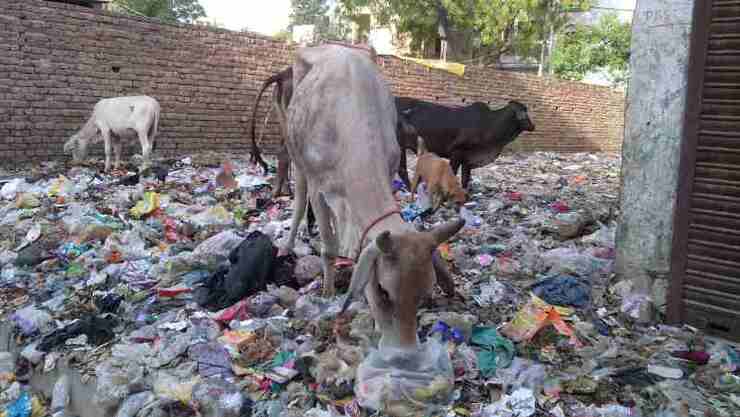
Photo: Starved cows eating household hazardous waste near a housing colony of Delhi. Dirty scenes like this are common in the national capital. Photo: Rakesh Raman / RMN News Service (Representational Image)
Donation to RMN Foundation