Guide to Decoding Managed Illusions: Identifying Political Propaganda in Entertainment
In an era of managed illusions, the ultimate democratic act is the ability to perceive the rhythmic fluctuations of power hidden behind the cinematic smokescreen.
By Rakesh Raman
New Delhi | February 17, 2026
1. Introduction: The Concept of the “Managed Illusion”
In the contemporary landscape of political communication, the traditional boundary between a functioning democracy and a carefully orchestrated performance has collapsed. To analyze this shift, we must employ the semiotic framework of the “managed illusion.” This term describes a state of institutional hollowing where the signifiers of democracy remain present while the underlying democratic substance has been extracted.
Definition: Managed Illusion: A “managed illusion” refers to a political environment where the aesthetic architecture of democracy—including elections, judicial proceedings, and a free press—is maintained as a facade to mask systemic institutional capture. In this state, public discourse is not a product of organic civic engagement but a scripted narrative managed by dominant political actors to manufacture consent and obscure authoritarian drift.
For the narrative analyst, identifying these illusions is a foundational necessity. When democratic processes are reduced to a performance, entertainment media becomes the primary stage for state-aligned messaging. Understanding this allows the citizen-viewer to transition from a state of passive consumption to one of critical decoding, distinguishing between legitimate storytelling and the “smokescreens” designed to protect entrenched power.
This analytical journey begins by examining how research-driven fiction can be weaponized to expose the very systems of control that traditional media fails to address.
2. Understanding the “Smokescreen” Film Project
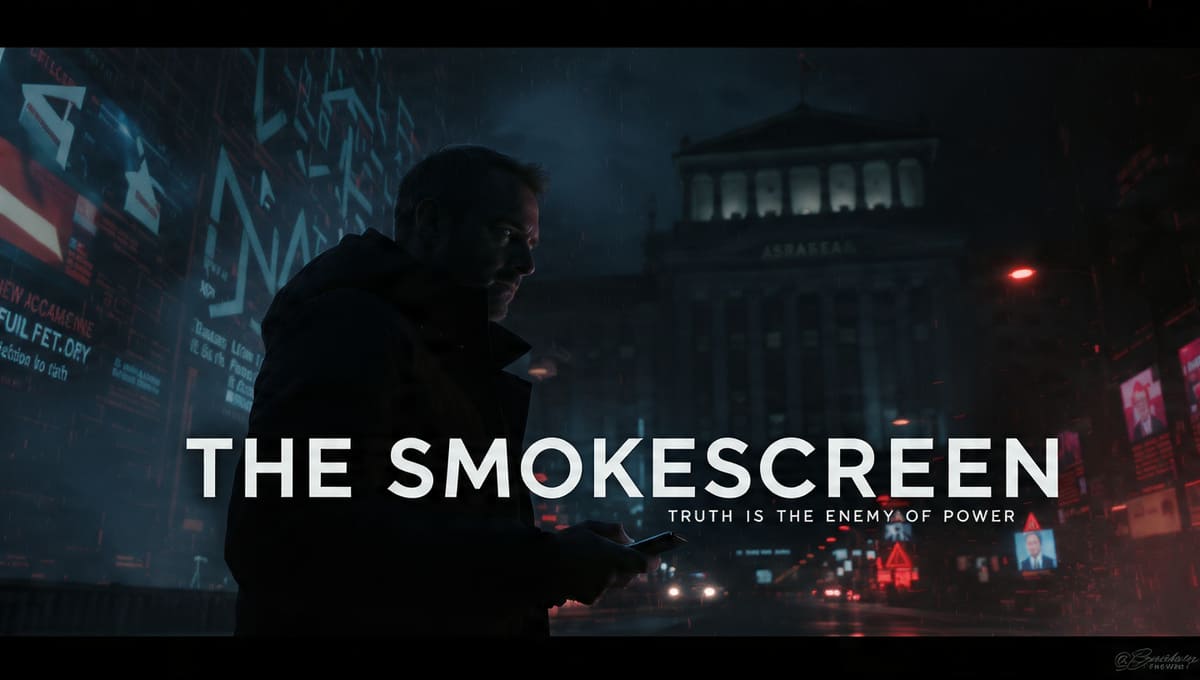
To bypass the cognitive filters and partisan censorship inherent in legacy media, independent creators are utilizing “proxy narratives.” A primary example is the film project The Smokescreen. By situating its analysis within the fictional nation of Astraea, the project allows viewers to observe the mechanisms of the “Astraea Protocol”—a blueprint for systemic institutional capture—without the immediate affective interference of domestic political tribalism.
Fiction vs. Reality
| Elements of the “Astraea” Narrative | Corresponding Real-World Concerns (RMN News 2026 Report) |
| Institutional Capture: The methodical takeover of state agencies by a central political entity. | Systematic Erosion of Indian Democracy: The hollowing out of democratic guardrails as documented in RMN News research. |
| The Astraea Protocol: A fictional operational manual for manipulating a nation’s destiny. | EVM Manipulation: Documented irregularities in Electronic Voting Machines and the integrity of the 2026 electoral process. |
| Astraean Political Thriller: A narrative designed to expose structural corruption. | Independent News Analysis: The RMN model of DOI-based, citable research used to counter narrative hegemony. |
Key Insight: The tactical benefit of the Astraea setting lies in its ability to present high-level research on institutional hollowing through a semiotic proxy. This allows the audience to recognize patterns of authoritarianism—such as the manipulation of voting technologies—through a detached, analytical lens that would be otherwise obscured by the noise of legacy news cycles.
While research-driven fiction exposes the protocol, state-aligned cinema replicates it by leveraging affective narratives to bypass cognitive scrutiny.
3. Case Studies in Nationalist Cinema: Vengeance and Masking
Nationalist cinema serves as a primary tool for “affective displacement,” where complex political failures are reframed as emotional triumphs. Films like Dhurandhar: The Revenge and Battle of Galwan are not merely entertainment; they are strategic interventions designed to create a smokescreen during periods of significant political upheaval.
These productions frequently employ the 3 Most Common Narrative Tropes to sustain narrative hegemony:
- Affective Vengeance: Utilizing “revenge” archetypes to simplify multifaceted geopolitical tensions into binary moral conflicts.
- Institutional Masking: Constructing a heroic cinematic front to distract from domestic crises, such as the “mysterious and suspicious” fatal plane crash of Maharashtra leader Ajit Pawar.
- Symbolic Shielding: Using nationalist iconography to preemptively frame any critical inquiry into military transparency or diplomatic failures as “anti-national.”
Key Insight: The strategic value of nationalist cinema is intrinsically tied to its timing. These films act as a “narrative sedative” during crises. For instance, Battle of Galwan functions to obscure real-world transparency issues, specifically the unpublished memoir of a former Army Chief that offers a counter-narrative to official accounts. Similarly, these films distract from acute diplomatic crises, such as the foiled U.S. assassination plot and subsequent allegations of “transnational repression” that have strained international relations.
By masking these scandals through high-intensity emotion, the state ensures that the “managed illusion” remains intact, even as social cohesion begins to fray.
4. Marginalization and Selective Storytelling
The “managed illusion” is maintained not only by what is shown but by who is systematically excluded. Cinematic propaganda contributes to the social and political marginalization of specific groups, reinforcing the “Authoritarian Drift.” Films like Lahore 1947 often operate within this framework, portraying specific demographics—such as Indian Muslims—through a lens of selective storytelling that aligns with state-preferred narratives of exclusion.
Note: The Authoritarian Drift: There is a direct correlation between cinematic propaganda and the “Authoritarian Drift” cited in RMN News research. When entertainment consistently “others” specific social or religious groups, it provides the cultural justification for real-world institutional hollowing and the erosion of democratic equality.
Key Insight: The “so what?” of cinematic marginalization is the eventual normalization of political exclusion. By hollowing out the representative diversity of a nation within its stories, propaganda prepares the public to accept a reality where those same groups are hollowed out of the democratic process.
To navigate this landscape, the viewer requires a clinical toolkit for decoding the screen.
5. The Media Literacy Toolkit: Identifying the “Smokescreen”
Use this diagnostic framework to determine if a narrative is a vehicle for truth or a tool of the “managed illusion.”
Critical Questions for the Modern Viewer
- Analyze the Timing: Is the film’s release synchronized with an election cycle, a major corruption scandal (e.g., Adani Group legal cases), or economic upheaval?
- Identify Affective Displacement: Does the narrative use “vengeance” or “nationalist pride” to bypass the need for factual explanations of policy or military outcomes?
- Evaluate Marginalization: Are minority demographics portrayed as monolithic antagonists, mirroring real-world political marginalization?
- Audit the Evidence Base: Is the film’s premise countered by independent, DOI-based research or unpublished institutional memoirs?
- Detect Institutional Capture: Does the film glorify leadership while ignoring documented allegations of corruption or “transnational repression” (e.g., foiled international assassination plots)?
Key Insight: Utilizing an independent news model—such as RMN News—functions as a “global pulse monitor.” By cross-referencing entertainment narratives against research-driven, independent analysis, viewers can perceive the rhythmic fluctuations of world events through the haze of state-sponsored propaganda.
6. Conclusion: Beyond the Newsroom Dinosaur
We are witnessing the “Death of the Newsroom Dinosaur.” As traditional legacy media models collapse—evidenced by structural obsolescence and mass layoffs at institutions like The Washington Post—a new frontier of media has emerged. In this vacuum, the “managed illusion” thrives, but so does the potential for narrative resistance.
The rise of AI-assisted storytelling is a critical component of this new landscape. Independent creators, such as Rakesh Raman with the Robojit and The Smokescreen projects, are using AI “character lock sheets” and automated manufacturing pipelines to lower production costs. This technological shift allows independent analysts to bypass the “Institutional Capture” of traditional film studios, weaponizing cinema to expose corruption and the “Astraea Protocol” directly to the public.
Media literacy is no longer a peripheral skill; it is the essential defense against the hollowing of our reality. By mastering the ability to decode narrative hegemony, the passive consumer evolves into an active analyst of the world.
Final Takeaway: In an era of managed illusions, the ultimate democratic act is the ability to perceive the rhythmic fluctuations of power hidden behind the cinematic smokescreen.
By Rakesh Raman, who is a national award-winning journalist and social activist. He is the founder of a humanitarian organization RMN Foundation which is working in diverse areas to help the disadvantaged and distressed people in the society.
Donation to RMN Foundation