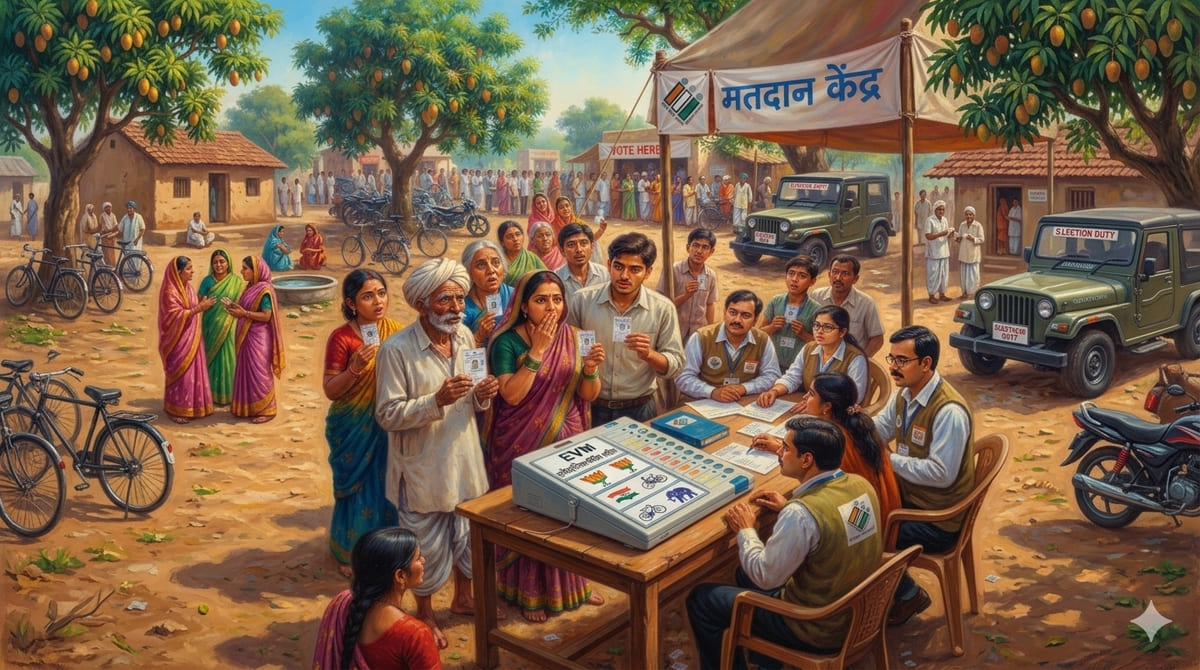
Why EVM Opacity Divests Citizens of Transparent Voting Rights and Signals Democratic Erosion in India
Electronic Voting Machines, even when paired with limited VVPAT systems, prevent voters from independently verifying that their choices are accurately recorded and counted. This opacity undermines the fundamental right to a transparent ballot and erodes public confidence in democratic processes. Returning to verifiable paper ballots remains essential to restore auditability and trust, regardless of the number of complaints raised.
RMN Foundation Democracy Desk
New Delhi | October 4, 2026
Electronic Voting Machines (EVMs) form the backbone of India’s contemporary electoral system. Yet sustained questions about their security, auditability, and transparency have elevated the debate far beyond technical malfunction. At its core, the controversy asks a foundational democratic question: Can citizens, candidates, and political parties independently confirm that votes are recorded and counted exactly as cast?
The right to vote encompasses more than the physical act of selecting a candidate. It includes the right to transparency, independent verification, and post-election auditability. When an electronic system records votes in a manner that cannot be fully inspected by the public or opposition stakeholders, that right is diminished. Limited Voter Verifiable Paper Audit Trail (VVPAT) mechanisms—where a slip is briefly displayed before being sealed—do not fully close this gap if only a small sample of slips is counted or if mismatches between electronic and paper records lack robust, independent reconciliation.
Even a single voter’s legitimate complaint against EVMs highlights a structural vulnerability. In a democracy, electoral integrity cannot rest on institutional assurances alone. Technical safeguards claimed by the Election Commission of India—standalone design, randomization, chain-of-custody protocols, and administrative checks—must be accompanied by verifiable public scrutiny. Without end-to-end auditability accessible to independent observers, confidence erodes. Public trust is not a secondary benefit of elections; it is a prerequisite for legitimacy.
Paper ballots offer a straightforward solution to this transparency deficit. A physical ballot creates a tangible, countable record that voters, agents, and observers can examine. Discrepancies become visible and resolvable through open counting. Global voices, including technology leaders and political figures, have repeatedly underscored the risks of electronic systems precisely because software and hardware can introduce opaque points of failure that paper avoids.
Concerns about EVM design, manufacturing access, storage, transportation, VVPAT sampling rates, and the absence of comprehensive independent technical audits are therefore not fringe objections. They address whether India’s electoral architecture meets the standards of a transparent democracy. When citizens cannot verify outcomes for themselves, the system risks becoming a managed process rather than a fully accountable one.
RMN Foundation continues to document research, official positions, court developments, political statements, and evidence on this issue through its EVM Research & Transparency Hub. The goal is not partisan advocacy but the preservation of democratic integrity. Restoring paper ballots—or at minimum instituting full, mandatory VVPAT counting with public access to verification data—would reaffirm that every vote is not only cast but demonstrably counted as intended.
Transparent elections are the bedrock of representative government. Addressing EVM-related opacity is essential to prevent the gradual divestment of citizens’ rights and to halt further democratic erosion.
Donation to RMN Foundation