Tag: Corruption

Representational AI-generated image of a street protest. Photo: RMN News Service

Global Stability and Institutional Integrity: A February 2026 Intelligence Briefing

Representational AI-generated image of a street protest. Photo: RMN News Service

Global Stability and Institutional Integrity: A February 2026 Intelligence Briefing

The intelligence landscape of 2026 is characterized by a convergence of domestic institutional decay and the rapid acceleration of technological power. From the “smokescreen” of Indian electoral opacity to the “brutal” acknowledgments of state violence in Iran, the failure of domestic integrity is necessitating a move toward international accountability.

By Rakesh Raman
New Delhi | February 3, 2026

1. The Erosion of Electoral Transparency: Case Study – India

Electoral verification represents the terminal safeguard of democratic legitimacy. In the current geopolitical climate, the implementation of technological “smokescreens” has evolved into a primary risk vector, threatening to replace representative governance with managed illusions of consent. When the technical mechanisms of suffrage become opaque, they cease to be tools of the citizenry and instead function as instruments of institutional capture.
The “Smokescreen” research analysis highlights a critical failure in India’s Electronic Voting Machine (EVM) and VVPAT infrastructure. The core risk is the decoupling of the “right to vote” from the “right to verify.” Within this framework, the ability of the voter to ensure their choice is accurately recorded, counted, and reflected is effectively extinguished. This systemic opacity suggests that Indian electoral outcomes are no longer a matter of public record but of technical assertion, fundamentally compromising the integrity of the state’s democratic claims.

Indicators of Institutional Capture in India

Indicator Description Risk Assessment
Verification Deficit Extinguishment of the “right to verify” electronic counts. Total disenfranchisement via technical opacity.
Symbolic Observance Rebranding “National Voters’ Day” amid widespread fraud allegations. Transition to “National Deception Day” metrics.
Systemic Opacity Use of EVM/VVPAT tech to mask real-time counting. Primary source of irreversible public distrust.
External Outreach Deployment of specialized microsites to bypass domestic blocks. Necessity for international oversight engagement.

Strategic Warning: The persistent decay of domestic oversight in India has reached a point of no return. As internal checks and balances are neutralized, the preservation of democratic norms necessitates an immediate shift toward international intervention. This erosion facilitates a transition toward the extra-sovereign legal mechanisms explored in subsequent sections of this briefing.

2. Transnational Corruption and the Nexus of Private-Public Power

The strategic danger of “institutional collusion” represents a profound threat to the global rule of law. This occurs when the boundaries between private corporate interests and the public civil service dissolve into a singular, self-serving entity. Such a merger allows the administrative state to bypass traditional oversight, concentrating power in a manner that is often insulated from domestic prosecution, thereby requiring robust international regulatory responses to maintain market stability.

The legal proceedings initiated by the U.S. Securities and Exchange Commission (SEC) against Gautam Adani underscore this shift. The SEC’s successful service of a civil fraud lawsuit against Adani—an Indian billionaire and perceived close partner of Prime Minister Narendra Modi—functions as a primary volatility vector for Foreign Direct Investment (FDI). This action signals to global markets that high-level political alignment no longer provides immunity from international legal reach. The “Modi-Adani” nexus is now a matter of global regulatory scrutiny, testing the limits of sovereign protection against international anti-corruption frameworks.

Domestically, the “Widehouse Corruption Scandal” involving Delhi IAS (Indian Administrative Service) officers serves as a microcosm of administrative impunity. Despite detailed complaints regarding corruption and institutional collusion within Delhi housing societies, the Ministry of Home Affairs (MHA) has issued a response characterized by editor Rakesh Raman as “ceremonial” and “result-less.” This failure to act on documented “Housing Society Crimes” validates the “Smokescreen” theory of a managed democracy. When the MHA ignores granular corruption filings, it reinforces a culture of administrative impunity that erodes public trust and facilitates broader systemic collapses in governance. This persistent corruption in high-level administration creates the vacuum required for state-sanctioned violence and civil unrest to take root.

3. State-Sanctioned Violence and Political Volatility

The admission of state-sanctioned violence by regime leaders carries severe strategic implications for regional stability. When a regime acknowledges the lethal suppression of its own populace, it signals a shift from covert control to overt elimination of political opposition as a primary tool for survival. These admissions generally indicate that the scale of unrest has surpassed the state’s capacity for narrative control, entering a phase of high-risk volatility.

Iran’s Supreme Leader Ayatollah Ali Khamenei recently acknowledged that “thousands” were killed during civil unrest. This “brutal” response, while a demonstration of force, has decimated Iran’s international standing and increased its geopolitical isolation. Despite mounting international pressure, the regime’s reliance on lethal force suggests a deepening structural instability that threatens long-term regional security.

For policy advisors, the following global patterns constitute high-risk indicators of state-driven volatility:

  • Suspicious Deaths of Figures: A rising global trend of unexplained fatalities among political dissidents.
  • Alleged Assassinations: Targeted hits against figures challenging established regime hierarchies.
  • Unexplained Disappearances: The systemic “vanishing” of activists, indicating a breakdown in the legal right to life.
  • Transnational Political Signaling: Venezuelan opposition leader María Corina Machado presenting her 2025 Nobel Peace Prize medal to U.S. President Donald Trump illustrates an attempt to leverage international prestige to bypass domestic roadblocks.

Note on Diplomatic Tension: Machado’s presentation of her medal has prompted a rare official clarification from the Norwegian Nobel Committee regarding the non-transferability of the award. This adds a layer of diplomatic friction to an already volatile situation. As local safety nets fail to protect political actors, the global community must increasingly pivot toward specialized judicial innovations to enforce accountability.

4. Evolving Frameworks for International Accountability

The emergence of “Special Tribunals” and supranational entities marks the new frontier for enforcing the global rule of law. These bodies are specifically architected to address gaps where traditional domestic judiciaries have been compromised by institutional capture or sovereign aggression.

A primary model for this accountability is the establishment of the Special Tribunal for the Crime of Aggression against Ukraine. This joint agreement between the Council of Europe and the European Union serves as a precedent for future geopolitical accountability, specifically targeting the act of state-level aggression. By moving beyond traditional domestic limits, the international community is signaling a new era of supranational enforcement.

This shift is mirrored in the leadership transition within the Council of Europe. The election of Petra Bayr as President of the Parliamentary Assembly (PACE) brings the “Socialist, Democrat, and Green” agenda to the forefront. Bayr’s leadership is expected to drive a specific shift toward the integration of environmental protection into international law, aligning social equality with ecological sustainability.

Furthermore, a new study reveals broad citizen support for a “world parliament“—a citizen-elected body intended to manage global issues. While a long-term governance trend, it indicates a growing public rejection of the traditional nation-state model in favor of democratic structures that transcend borders. These legal and political frameworks are being simultaneously reshaped by the rapid ascent of Artificial Intelligence, which is fundamentally altering the mechanisms of both governance and economic power.

5. The Geopolitical Impact of Artificial Intelligence and Economic Realignment

Artificial Intelligence (AI) has transitioned from an efficiency-enhancing tool to a primary engine for corporate innovation and revenue growth. According to the IBM Institute for Business Value, this transition will define the global economic landscape by the end of the decade. However, this shift risks creating a new digital divide, where technological dominance translates directly into sovereign-level power.

The risks of “AI-driven discrimination” are now a central concern for the Council of Europe, which has published warnings on how algorithmic bias challenges fundamental rights. In the judicial sector, India is moving toward an AI Roadmap to replace traditional “judge-centric” processes, which have been criticized as “opaque, subjective, and vulnerable to manipulation.” The objective is to transition toward an “AI-driven” system to mitigate these human biases, though the risk of embedded algorithmic prejudice remains high.

The “Tech Cold War” has escalated into a sovereign-level gatekeeping exercise:

  • Google vs. OpenAI: Google’s legal attempts to block the sharing of search data with OpenAI represent a strategic effort to maintain search dominance and data harvesting as a foundation of national economic infrastructure.
  • National Workforce Integration: OpenAI’s “Education for Countries” and the “Prism” workspace (powered by GPT-5.2) are designed specifically for scientists to write and collaborate. These tools represent a move to integrate AI directly into the intellectual and scientific infrastructure of nations, potentially bypassing traditional national sovereignty.

Simultaneously, massive economic realignments are coalescing around the India-EU Trade Pact, labeled the “mother of all deals,” and the upcoming 9th World Investment Forum in Doha, Qatar.

The Three Strategic Pillars of Global Economic Realignment

  1. Market Scale: Creation of free trade zones encompassing approximately 2 billion people.
  2. Economic Weight: These agreements represent roughly 25% of the global GDP.
  3. Judicial Modernization: A decisive shift from “judge-centric” to “AI-driven” judicial processes to improve investment climates and mitigate subjective institutional manipulation.

Conclusion

The intelligence landscape of 2026 is characterized by a convergence of domestic institutional decay and the rapid acceleration of technological power. From the “smokescreen” of Indian electoral opacity to the “brutal” acknowledgments of state violence in Iran, the failure of domestic integrity is necessitating a move toward international accountability. Policy advisors must now synthesize traditional geopolitical risk assessment with technological oversight, as the role of AI in judicial reform and the emergence of “Special Tribunals” reshape the global order. Navigating this realignment requires a prioritization of verification and transparency as the only viable counters to systemic corruption and institutional capture.

By Rakesh Raman, who is a national award-winning journalist and social activist. He is the founder of a humanitarian organization RMN Foundation which is working in diverse areas to help the disadvantaged and distressed people in the society.

Top Photo: Representational AI-generated image of a street protest. Photo: RMN News Service
Understanding Corruption in Delhi's Housing Societies | RMN Foundation Report

The Secret Rulebook: Understanding Corruption in Delhi’s Housing Societies

Understanding Corruption in Delhi's Housing Societies | RMN Foundation Report

The Secret Rulebook: Understanding Corruption in Delhi’s Housing Societies

The corruption is guaranteed to continue because the official channels for accountability and justice have effectively collapsed. Residents who try to fight back find themselves trapped in a system that is either indifferent, corrupt, or actively working against them.

By Rakesh Raman
New Delhi | January 12, 2026

Introduction: The Broken Promise of Community Living

A cooperative housing society is supposed to be a community built on shared responsibility and mutual benefit. It’s an idea that promises residents a secure, harmonious, and well-managed place to live. However, for millions of people in Delhi, this promise has been broken. Their communities have become centers of crime, widespread corruption, and systemic harassment.

This document explains why this is happening by focusing on one central problem: a deliberate and calculated lack of transparency. We will explore how a simple rule designed to ensure honesty has been systematically ignored, creating a hidden world where corruption is allowed to thrive.

1. The Simple Rule That Was Meant to Keep Things Honest

Every housing society is run by an elected group of residents called a Management Committee (MC). To prevent these committees from becoming corrupt, the Delhi Government’s Registrar Cooperative Societies (RCS) office created a simple but powerful solution: every single society must have a transparent, regularly updated website.

This rule has been official policy since at least 2015 and has been reinforced multiple times. Complying with this rule has almost no cost, as free software and platforms are widely available. The goal was to empower residents with information and hold their elected MCs accountable.

What Every Society Website Must Show

The RCS directives are supposed to ensure that a society’s information must be publicly available and kept up-to-date. The information may include:

  • Details of all members of the society.
  • Complete records of all financial transactions, including purchase documents and vouchers.
  • Details of all contracts and the criteria used for the appointment of vendors.
  • Regular updates on the status of all legal cases involving the society.
  • An online form for members to register complaints and an official email for communication.
  • A complete record of all internal and external communications.
  • Instant and regular updates of all communications between members and the MC, ensuring a real-time record of interactions.

This clear rule was designed to be a straightforward tool for honesty. However, the reality on the ground reveals a massive gap between this policy and what is actually happening.

2. A Rule Ignored: The Widespread Defiance

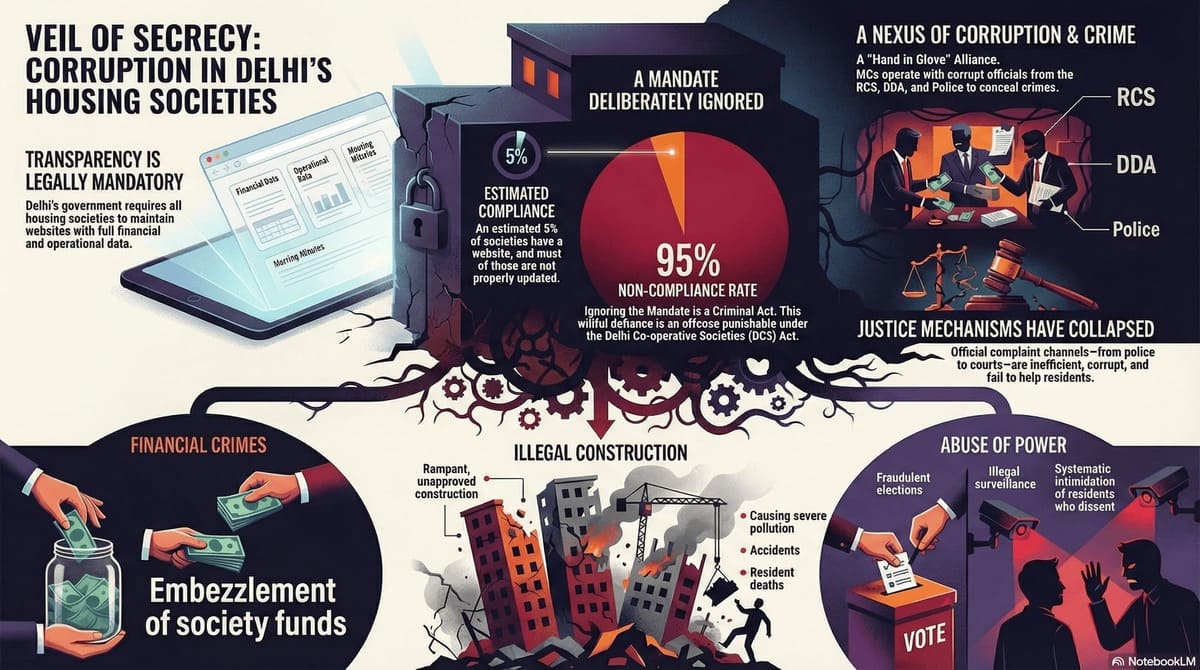
The scale of the problem is staggering. An estimated 95% of housing societies in Delhi do not have a website. Of the mere 5% that do, most are useless because they are never updated with the required information.

According to the investigative report, this isn’t a simple oversight or a technical challenge. It is described as a “willful defiance” and a “blatant ignoring” of a legally binding government order. The law is clear on this point:

Failing to establish and maintain an updated website is legally considered an “offence” and a “criminal act”. The MC members responsible can be prosecuted under the Delhi Co-operative Societies (DCS) Act and relevant sections of the Indian Penal Code (or its successor, the Bharatiya Nyaya Sanhita, 2023).

This exposes a critical question: How do so many Management Committees get away with openly breaking the law?

3. The Secret Partnership: How Corruption is Protected

The primary reason this defiance is so widespread is a corrupt partnership where Management Committees operate “hand in glove” with government officials. This secret alliance creates a protective shield, allowing MCs to ignore the law without any fear of consequences.

This network of complicity extends across multiple government bodies, each playing a role in protecting corrupt MCs.

The Network of Complicity

Government Body How They Help Corrupt MCs
Registrar Cooperative Societies (RCS) Allegedly accepts bribes to ignore non-compliance with the website rule and closes resident complaint cases without taking any real action.
Delhi Development Authority (DDA) Supports corrupt MCs in illegal activities, particularly unauthorized construction projects.
Delhi Police Described as “perhaps the most corrupt police force in the country”; consistently fails to take action against MCs and has been accused of deliberately omitting their names from official reports (FIRs) for serious crimes.
Municipal Corporation of Delhi (MCD) Implicated in the network of connivance, further enabling illegal activities.
Other Delhi Govt. Departments This includes the Delhi Jal Board (DJB), Delhi Fire Service (DFS), and Delhi Pollution Control Committee (DPCC), expanding the protective shield.
Ruling Politicians Allegedly receive a share of the bribe money collected by departments, ensuring they turn a blind eye to the widespread corruption.

This network ensures that the very system designed to regulate housing societies is instead used to protect criminal activity. This official protection allows a range of harmful and illegal acts to flourish within these communities.

4. The Real-World Harm: What Happens When No One is Watching

This deliberate secrecy is not a victimless crime. It directly enables criminal activities that harm residents, violate their rights, and damage their communities both financially and physically.

Financial Crime

Without transparent records, MCs can easily misuse society funds. Key examples include:

  • Swindling society funds through large, expensive projects where costs can be inflated and money embezzled.
  • Illicitly selling car parking spaces to residents in exchange for substantial bribes.
  • Allowing society staff, such as plumbers and electricians, to “fleece the residents by charging heavy amounts even for small tasks,” likely while taking illicit commissions.

Dangerous Construction

The lack of oversight allows illegal Floor Area Ratio (FAR) construction to run as a massive “extortion racket.”

  • This activity subjects thousands of residents, including children and the elderly, to severe and prolonged noise and dust pollution.
  • This unauthorized construction often leads to serious and even fatal accidents, all while generating illegal profits for the MCs and their official partners.

Abuse of Power

Unchecked by any real oversight, MCs can abuse their authority and violate the human rights of residents.

  • They hold fraudulent elections to stay in power, with the same members often rotating posts for decades.
  • They intimidate residents who dare to complain or ask questions.
  • They allow nuisances that degrade the quality of life, such as tolerating “ferocious dogs” that disturb residents or allowing constant, disruptive construction that turns buildings into “war-torn regions.”

When residents try to seek help from the authorities to stop these abuses, they discover that the systems designed to protect them are completely broken.

5. A System of Failure: Why Getting Help is Nearly Impossible

The corruption is guaranteed to continue because the official channels for accountability and justice have effectively collapsed. Residents who try to fight back find themselves trapped in a system that is either indifferent, corrupt, or actively working against them.

An analysis of the four main channels for recourse reveals a consistent pattern of failure:

1. RCS Inquiries: These are described as “perfunctory” or superficial. The RCS may send a notice, but cases are routinely closed without providing any relief to the resident, allegedly because officials are bribed by the MCs.

2. The Courts: The judicial system is “overcrowded” and “inefficient.” This means that even if a resident goes to court, they face extremely long delays and often receive unjust decisions, making it an unworkable option for most.

3. Online Grievance Portals: Government portals are often managed by the same corrupt officials who are part of the problem. As a result, complaints are closed without any meaningful action being taken.

4. The Delhi Police: The police force consistently fails to act on complaints. In cases of serious crimes, such as deaths from illegal construction, they have been accused of deliberately removing the names of the responsible MC members from official reports.

This total system failure leaves residents with virtually no official way to fight back against the corruption and abuse they face.

6. A Call for Real Change

The problems in Delhi’s housing societies are not just isolated incidents of mismanagement. They are the direct result of a deliberate, systemic, and corrupt ecosystem built on a foundation of secrecy. The failure to enforce one simple rule—the mandatory website—has enabled a criminal alliance between Management Committees and government officials to flourish, turning communities into personal fiefdoms.

The source report goes so far as to describe Delhi as the “corruption capital of India,” highlighting that this issue is part of a much larger crisis of governance. To restore the rights of millions of residents and reclaim the promise of cooperative living, fundamental reforms are needed. The two most critical and immediate actions are:

  • Prosecuting non-compliant MC members to enforce the law and create genuine accountability.
  • A complete and transparent revamp of the corrupt RCS office to break the cycle of complicity.

The source report argues that given the scale of the crisis, more drastic measures are necessary to break the criminal enterprise:

  • A call for a “separate jail” to be built specifically for corrupt MC members and the bureaucrats who enable them.
  • The need for intervention from international human rights and law-enforcement agencies, given the “categorical failure of India’s judicial forums to provide justice.”

Top Image: Understanding Corruption in Delhi’s Housing Societies | RMN Foundation Report

By Rakesh Raman, who is a national award-winning journalist and social activist. He is the founder of a humanitarian organization RMN Foundation which is working in diverse areas to help the disadvantaged and distressed people in the society.

He has been running for the past 8 years a community-driven anti-corruption social service “Clean House” to help the residents of Delhi who are victims of crime and corruption committed by the management committees (MCs) of Delhi’s Cooperative Group Housing Societies (CGHS). 

Representational AI-generated image of mobile phone users in India. Photo: RMN News Service

From AI Treaties to Social Media Bans: 5 Shocking Global Shifts from Late 2025

Representational AI-generated image of mobile phone users in India. Photo: RMN News Service

From AI Treaties to Social Media Bans: 5 Shocking Global Shifts from Late 2025

These five dispatches from late 2025 reveal a clear trend: governments globally are escalating their efforts to control technology and assert authority in novel ways.

By Rakesh Raman
New Delhi | December 17, 2025

Introduction: The Stories Beneath the Noise

In an era of non-stop information, it’s easy for the daily flood of headlines to obscure the signals of profound global change. The news cycle churns relentlessly, but beneath the surface of the major stories, under-the-radar developments are signaling tectonic shifts with far greater long-term consequences. These developments often go unnoticed, yet they offer a clear glimpse into the future of governance, technology, and individual rights.

This article cuts through the noise to highlight five pivotal developments from December 2025. From a nation banning social media for its youth to the world’s first legally binding treaty on artificial intelligence, these stories reveal significant shifts in how governments are confronting the challenges of the modern world. Here, we unpack what makes each of these events so significant and what they signal for the year to come.

1. Australia’s World-First Ban: Social Media Goes Dark for Under-16s

In a move with global ramifications, Australia is proceeding with a “world-first” ban that prevents individuals under the age of 16 from accessing social media. This controversial legislation, which directly affects major digital platforms, is designed to safeguard children from a growing list of online dangers.

The initiative represents one of the most aggressive government interventions into the digital lives of young people to date. While the stated goal is child protection, the policy ignites a critical debate. It pits the responsibility of the state to protect its most vulnerable citizens against fundamental questions of digital freedom, parental rights, and the immense technical challenges of enforcing such a widespread ban. The world is watching to see if this bold experiment in digital regulation becomes a new global standard or a cautionary tale.

2. A Legal First: Europe Creates a Binding Treaty for AI and Human Rights

The Council of Europe has established a landmark legal precedent with its new Framework Convention on AI. This is not another set of ethical guidelines or recommendations; it is the “first-ever international legally binding agreement” designed to govern the development and use of artificial intelligence.

The convention’s core purpose is to serve as a crucial link between human rights-based governance and technical AI standardization. For the first time, there is an international legal instrument ensuring that the design and deployment of AI systems must align with established principles of human rights, democracy, and the rule of law. This move marks a critical turning point, attempting to impose order and accountability on a technology that is advancing at an exponential rate.

3. An Unexpected Path to Citizenship: The ‘Trump Gold Card’

In a policy move that stunned observers, President Trump has launched the “Trump Gold Card,” a new initiative offering a “direct path to citizenship for qualified individuals.” The announcement is deeply counter-intuitive, coming from a political figure whose brand has been defined by a hardline stance on immigration, epitomized by promises of mass deportations and a border wall.

So, what explains this unexpected pivot? The motivations are likely a pragmatic blend of economic and political strategy. Economically, the program could be a targeted effort to attract high-skilled talent, entrepreneurs, and wealthy investors, creating a streamlined “brain gain” to boost American innovation and tax revenues. Politically, it may be a calculated move to appeal to business communities and moderate voters by showcasing a more nuanced approach to immigration, countering the narrative that his policies are purely restrictive. This selective, merit-based channel for citizenship represents a significant, and surprising, evolution in his administration’s strategy.

4. In India, a Cybersecurity App Comes Pre-Installed on Every New Phone

The Indian government has issued a mandate requiring all new smartphones manufactured or sold in the country to come pre-loaded with “Sanchar Saathi,” a state-run cybersecurity application. The official aim of the policy is to bolster the digital security of millions of citizens in a rapidly expanding mobile market.

This directive places India at the center of a global conversation about the relationship between state security and personal privacy. On one hand, the government presents the move as a necessary step to protect users from cyber threats. On the other, the mandatory installation of a government-run app on every personal device raises critical questions about potential state surveillance, data privacy, and the erosion of user choice in a democratic society.

5. A Stark Message: China’s Extreme Anti-Corruption Measure

China sent a powerful and unambiguous message about its stance on financial crimes with the execution of Bai Tianhui, the former general manager of China Huarong International Holdings (CHIH). Bai was found guilty of corruption, and the state responded with the most severe penalty possible.

This event is a stark illustration of the intensity of China’s ongoing anti-corruption campaign. The use of capital punishment in a high-profile case of white-collar crime underscores the state’s absolute authority and its zero-tolerance approach to what it deems critical threats to its economic and political stability. It serves as a chilling warning to officials and executives operating within its system.

Conclusion: What Do These Signals Mean for Our Future?

These five dispatches from late 2025 reveal a clear trend: governments globally are escalating their efforts to control technology and assert authority in novel ways. From Canberra to New Delhi, governments are asserting greater control over the digital sphere. In Europe, new legal frontiers are being established to rein in artificial intelligence, while in the United States and China, political and legal authority is being wielded in surprising and definitive ways. The common thread is an increasingly interventionist state, grappling with the complexities of technology, security, and economic integrity.

These trends push us toward a fundamental question as we head into 2026. As governments worldwide take unprecedented steps to regulate our digital and public lives, where do we draw the line between protection and control?

Photo: Representational AI-generated image of mobile phone users in India. Photo: RMN News Service

By Rakesh Raman, who is a national award-winning journalist and social activist. He is the founder of a humanitarian organization RMN Foundation which is working in diverse areas to help the disadvantaged and distressed people in the society.

Representational Image of a Courtroom Created with Meta AI Image Generator

India Judicial Research Report 2025 Highlights Denial of Access to Justice and Institutional Corruption

Representational Image of a Courtroom Created with Meta AI Image Generator

India Judicial Research Report 2025 Highlights Denial of Access to Justice and Institutional Corruption

To ensure open access and academic traceability, the India Judicial Research Report 2025 has been archived on Zenodo, a global research repository developed under the European OpenAIRE program and operated by CERN.

New Delhi, October 11, 2025 — The latest India Judicial Research Report 2025 (IJRR 2025), released by Rakesh Raman, founder of the humanitarian organization RMN Foundation, has exposed the deep-rooted corruption, bias, and inefficiency plaguing India’s judicial system. The comprehensive 89-page report reveals how the courts have increasingly failed to provide citizens with fair and timely access to justice — a constitutional promise that now stands largely unfulfilled.

The study, which examines key issues such as judicial bias, pendency of cases, corruption in appointments, political interference, and digital dysfunctions, warns that India’s justice system is rapidly losing public trust. Ordinary citizens, activists, and marginalized groups often face systemic discrimination, prolonged delays, and arbitrary rulings, while politically connected individuals enjoy impunity through easy bail and procedural manipulation.

“Access to justice in India has become a privilege for the powerful rather than a right for every citizen,” said Rakesh Raman. “The denial of bail to activists and the routine protection of corrupt politicians demonstrate that the judiciary has abandoned both constitutional morality and public accountability.”

Research Scope and Methodology

Drawing from official data (National Judicial Data Grid), global indices (World Justice Project, Transparency International), and field investigations, the IJRR 2025 offers a detailed, evidence-based account of how corruption and administrative inertia have crippled India’s courts. The report also incorporates AI-assisted research and analytics to evaluate trends in case pendency, e-court implementation, and judicial appointments.

Key Findings

Case pendency exceeds 50 million, with little progress in disposal rates.

Judicial bias in bail cases overwhelmingly favors politicians and the affluent.

Digital initiatives such as e-filing remain dysfunctional due to lack of training and accountability.

India’s global ranking on the World Justice Project’s Rule of Law Index remains stagnant at 79th out of 142 countries.

Structural corruption has converted the judiciary into a political tool, with post-retirement “sinecures” influencing verdicts.

Zenodo Archival and Academic Citation

To ensure open access and academic traceability, the India Judicial Research Report 2025 has been archived on Zenodo, a global research repository developed under the European OpenAIRE program and operated by CERN. The report can be freely accessed, downloaded, and cited through its permanent Digital Object Identifier (DOI) on Zenodo.

This international archiving makes the IJRR 2025 accessible to researchers, policy analysts, and institutions worldwide, providing a verifiable reference for studies on judicial reform, corruption, and human rights in India.

About RMN Foundation

RMN Foundation is a humanitarian organization that works in the areas of human rights, anti-corruption, environment protection, and education for underprivileged communities. Through its research and advocacy initiatives, it aims to strengthen transparency, accountability, and rule of law in governance systems.

Read the full report here:
👉 India Judicial Research Report 2025 – RMN News Service

Archived for citation:
📘 Zenodo DOI (OpenAIRE / CERN Archive)

Rakesh Raman  |  LinkedIn  |  Facebook  Twitter (X)

Anti-Corruption Activist Demands Action Against Delhi IAS Officers in Widespread Corruption Scandal. Photo: RMN News Service

Anti-Corruption Crusader Demands Swift Action in Delhi Bureaucratic Scandal

Anti-Corruption Activist Demands Action Against Delhi IAS Officers in Widespread Corruption Scandal. Photo: RMN News Service

Anti-Corruption Crusader Demands Swift Action in Delhi Bureaucratic Scandal

The scandal, dubbed the “Widehouse Corruption Scandal,” involves a complex racket allegedly orchestrated by senior officials and their accomplices.

By Rakesh Raman

New Delhi, July 25, 2025 – An anti-corruption activist Rakesh Raman has escalated his call for accountability, urging authorities to prosecute several senior Indian Administrative Service (IAS) officers implicated in a sprawling corruption scandal in Delhi. 

Raman, who publishes The Integrity Bulletin and annual India Corruption Research Reports, alleges that these officials are part of a citywide crime network involving corrupt bureaucrats, politicians, police, judicial members, and builders’ mafia, collectively causing significant harm to Delhi residents.

In a formal complaint lodged with the Department of Personnel and Training (DoPT) and the Cabinet Secretariat on July 3, 2025, Raman highlighted that the DoPT has repeatedly directed the Cabinet Secretariat to investigate the officers’ alleged misconduct. 

As a department of the Government of India, among other responsibilities, the DoPT determines government policy for the maintenance of the integrity of the public services and eradication of corruption.

In an update, the DoPT responded to Raman’s complaint with an Office Memorandum dated July 21, 2025, again directing the Cabinet Secretariat to investigate the case of IAS officers at the level of Secretary to the Government of India. 

[ Also Read: How Criminals Abuse the Legal System in India to Attack Press Freedom ]

Despite these directives, no concrete action has been reported, prompting Raman to accuse authorities of deliberate inaction to shield the accused. Responses to Right to Information (RTI) queries indicate that the investigation remains “under process” with no visible progress.

The scandal, dubbed the “Widehouse Corruption Scandal,” involves a complex racket allegedly orchestrated by senior officials and their accomplices. Raman’s detailed report outlines the network’s modus operandi, claiming it has siphoned off thousands of crores of rupees. While some IAS officers are under scrutiny, their accomplices, including junior officials at the Delhi Development Authority (DDA), the office of Registrar Cooperative Societies (RCS), local criminals, and builders’ mafia, remain at large.

Raman has called for the immediate suspension and prosecution of the implicated officers, warning that failure to act within a stipulated timeframe could suggest complicity by higher authorities. The ongoing delay in addressing these allegations has fueled public discontent, with thousands of Delhi residents reportedly suffering due to unchecked corruption.

As the investigation stalls, Raman continues to push for transparency and justice, emphasizing the need for systemic reforms to curb bureaucratic corruption in India’s capital.

🚨 You can click here to read the full report including the names of the accused IAS officers.

By Rakesh Raman, who is a national award-winning journalist and social activist. He is the founder of a humanitarian organization RMN Foundation which is working in diverse areas to help the disadvantaged and distressed people in the society.

The Unrest: Representational Image of a Protest Created with Adobe Firefly Generative AI. By RMN News Service

The Unrest Magazine Chronicles Global Upheavals: From Transnational Repression to Domestic Crises

The Unrest: Representational Image of a Protest Created with Adobe Firefly Generative AI. By RMN News Service

The Unrest Magazine Chronicles Global Upheavals: From Transnational Repression to Domestic Crises

Raman Media Network (RMN) News Service emphasizes its commitment to independent fearless journalism, maintaining editorial freedom despite pressures and threats for the past 15 years, and urges financial support from its readers.

NEW DELHI – The latest June 16-30, 2025 issue of The Unrest magazine, published by RMN News Service, offers a comprehensive look at significant economic and political upheavals worldwide. This edition delves into critical international relations, domestic political challenges, and various global developments, underscoring the complex landscape of mid-2025.

The Unrest Magazine of RMN News. June 16-30, 2025 Issue
The Unrest Magazine of RMN News. June 16-30, 2025 Issue.

International Relations and Diplomatic Maneuvers: In a notable development concerning international relations, Indian Prime Minister Narendra Modi’s invitation to the G7 was reportedly contingent upon his government’s agreement to law enforcement cooperation, a condition set by Canadian Prime Minister Mark Carney. This arises amidst Canada’s strong stance, considering India’s alleged actions targeting Canadian citizens as a serious crime of Transnational Repression. A report within the magazine further indicates that an Indian agent kept former leader of Canada’s New Democratic Party (NDP), Jagmeet Singh, under close surveillance.

Diplomatic setbacks for India are also highlighted, with the United Nations Security Council (UNSC) dismissing India’s long-standing allegations of state-sponsored terrorism against Pakistan. The magazine also briefly mentions the ongoing Iran-Israel Conflict. International bodies are actively engaged, as seen with the Council of Europe’s call for an immediate ceasefire in Gaza and a high-level delegation from its Congress meeting with Ukrainian President Volodymyr Zelenskyy in Kyiv. Furthermore, NATO’s Defence Innovation Accelerator for the North Atlantic (DIANA) has launched ten new innovation challenges.

United States Politics and Immigration: Within the United States, the political climate remains contentious. More than half of respondents in 19 of 24 surveyed countries express a lack of confidence in Donald Trump’s leadership. President Trump has officially launched registration for the “Trump Card,” a new premium pathway designed to provide wealthy foreigners with access to the United States.

He has also implemented a travel ban on nationals from 12 countries, citing national security concerns. In response to intensified immigration raids and troop deployment, demonstrations have taken place in U.S. cities including New York, Chicago, and Atlanta. The magazine also covers the “No Kings” protests, a series of demonstrations across the U.S. organized to oppose the policies and perceived overreach of President Donald Trump’s administration.

Domestic Concerns in India: India is grappling with significant domestic challenges, described as its worst existential crisis. The sources indicate that the country’s 1.4 billion commoners are under grave threat from their own political rulers who are allegedly exploiting them. Rahul Gandhi has accused the ruling BJP of orchestrating “match-fixing” and “industrial-scale rigging” in Indian elections.

Instances of corruption and exploitation are prominent, including the Widehouse Corruption Scandal, described as a construction racket in Delhi run by criminal housing society MC members in collusion with corrupt officials. There’s also a case of malicious legal action in a Delhi court illustrating the exploitation of India’s judicial system to target independent journalists.

In Delhi’s Kalkaji, hundreds have been displaced after the Delhi Development Authority (DDA) razed illegal structures, even as Prime Minister Narendra Modi flagged off a fleet of electric buses in the city. Amidst these domestic issues, the RMN company has launched its ‘Promote with Pathway’ platform to give global recognition to startups and small businesses.

Global Governance and Other Topics: International bodies are actively addressing various fronts, with the Council of Europe organizing a major conference in Strasbourg where over 500 leading cybercrime experts gathered. The Council of Europe’s Group of States against Corruption (GRECO) has released a report expressing concern about threats to judicial independence. Global leaders are also urging critical action against money laundering and terror finance.

The magazine also touches upon broader societal topics, noting that there is no specific definition of terrorism, asserting it is only a form of political system clandestinely run by professional politicians of the world. The importance of green film-making for the future of cinema, aiming to save energy and reduce environmental harm, was highlighted by student expert Imrana. Additionally, AI-powered Virtual Worlds are mentioned.

Raman Media Network (RMN) News Service emphasizes its commitment to independent fearless journalism, maintaining editorial freedom despite pressures and threats for the past 15 years, and urges financial support from its readers.

👉 You can click here to read all issues of The Unrest magazine of RMN News.

👉 You can click here to download and read the June 16-30, 2025 issue of The Unrest magazine.