Tag: English

Multiple Subject Guide for Primary Learning

Multiple Subject Guide for Primary Learning

Multiple Subject Guide for Primary Learning Multiple Subject Guide for Primary Learning

RMN Foundation school – which provides modern education free of charge to deserving children – has introduced its new book to educate the students at primary level.

Written by RMN Foundation founder and teacher Rakesh Raman, the book is a multiple subject guide comprising the following subjects:

1. Moral and Behavioural Education

2. English

3. Arithmetic

4. Information Technology (IT) / Computers

5. General Knowledge

You also can read Raman’s Tech Tale Series which is an innovative storybook concept that aims to educate children in the high-tech area of information and communications technology (ICT) through interesting stories.

RMN Foundation has launched the next phase of its education awareness campaign in India with the introduction of a comprehensive research report. The campaign aims to get the quality of education improved in schools so that students could get suitable employment. It is also planning to open free residential schools for deserving children.

The activities of RMN Foundation are being run single-handedly (without any external support) by RMN Foundation founder Rakesh Raman, who is a government’s National award-winning journalist.

He had also been associated with the United Nations (UN) through United Nations Industrial Development Organization (UNIDO) as a digital media expert to help businesses use technology for brand marketing and business development.

Download the Book

You can click here to download the book.

Donation

As RMN Foundation has limited resources, it invites people to get involved and donate for the Foundation’s educational as well as other social activities.

Donation: Individual donors can click here to donate online and click here to pay with PayPal.

Contact

Rakesh Raman
Editor, RMN News Service [ Website ]
Founder, RMN Foundation [ Website ]
463, DPS Apts., Plot No. 16, Sector 4
Dwarka, Phase I, New Delhi 110 078, India
WhatsApp / Mobile: 9810319059 | Contact by Email
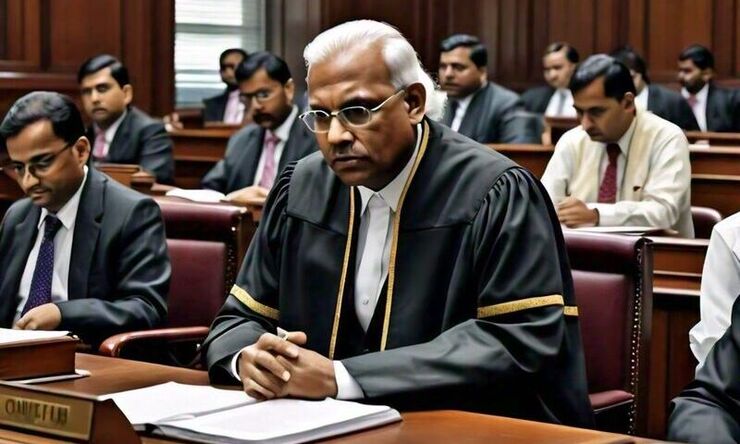
Representational Image of a Courtroom Created with Meta AI Image Generator

Why Most Court Judgments in India Are Flawed

Why Most Court Judgments in India Are Flawed. Representational Image of a Courtroom Created with Meta AI Image Generator.

Why Most Court Judgments in India Are Flawed

The excerpts from the “India Judicial Research Report 2024: Decline of the Indian Judiciary” are given below.

While the members of the judiciary are not quite qualified, the government is blindly increasing the number of courts and judges. 

A large number of lawyers and judges are not comfortable in the use of English in courts. While most judges are not quite educated, there are numerous flaws in their written judgements as well as spoken pronouncements. 

Similarly, most lawyers are so ignorant that they cannot write even a few sentences correctly in English language, which is commonly used in Indian courts. According to the Department of Justice, Government of India, Article 348(1) of the Constitution of India provides that “all proceedings in the Supreme Court and in every high court shall be in English language until Parliament by law otherwise provides.”

But there is scarce use of proper English in courts. As India ranks 134 out of 193 countries and territories on the 2023/24 Human Development Index (HDI), the performance of workers in all the professional fields is bad. The same is visible in the judicial profession where judges as well as lawyers lack skills to work effectively and deliver proper justice to the citizens.

RELATED REPORTS

[ India Judicial Research Report 2024 Released ]

[ India Judicial Research Report 2024: Decline of the Indian Judiciary ]

[ Negligible Use of Technology in Indian Courts: Research Report on Indian Judiciary ]

[ How Indian Judiciary Is Condemned in the World ]

[ Indian Judiciary Research Report: Professional Incompetence of Lawyers and Judges ]

The members of the Indian judiciary are not able to work properly because they do not understand English which propels the modern information-driven world. Therefore, they keep working as manual workers because of which litigants suffer as they cannot challenge wrong court decisions.

It is being observed that almost all the court judgements and other documents which are used as part of the judicial work in India are flawed. Some of the examples of these wrong judgements and incorrect use of language are included in the research report, “Risks of English Language Limitations in Indian Judiciary: Pitfalls and Solutions”. [ You can click here to download and read the full research report. ]

While the members of the judiciary are not quite qualified, the government is blindly increasing the number of courts and judges. The 2023 data shared in the Rajya Sabha by the Department of Justice, Ministry of Law & Justice, Government of India, reveals that in the 686 districts of India, there are 3,466 district court complexes which accommodate over 2 million advocates. In addition, 25 high courts and the Supreme Court are supposed to handle millions of court cases filed every year.

For the year 2023, for example, nearly 2.6 crore (26 million) new cases were instituted across various levels of courts. These include civil, criminal, and other types of cases at the Supreme Court, high courts, and subordinate courts. Since the number of judges in courts is pathetically low, they are not able to deliver proper justice to litigants.

Download: You can click here to download and read the India Judicial Research Report 2024 to support this editorial initiative.

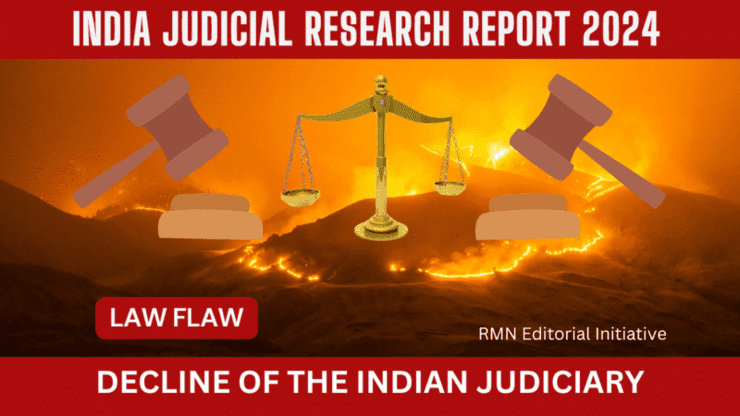
India Judicial Research Report 2024. Decline of the Indian Judiciary. Photo: RMN News Service

India Judicial Research Report 2024: Decline of the Indian Judiciary

India Judicial Research Report 2024. Decline of the Indian Judiciary. Photo: RMN News Service

India Judicial Research Report 2024: Decline of the Indian Judiciary

The report also analyzes the obsolete syllabuses in law colleges and universities which are not producing employable workforce for the Indian courts. 

The India Judicial Research Report 2024 discusses various factors that are responsible for the downfall of the Indian judiciary and the impact of this constant collapse on the litigants particularly who belong to the vulnerable sections of the society. 

With the help of some specific court cases, the report sheds light on the dwindling judicial processes in India, scarce use of technology, flawed application of law, judicial corruption, limited domain knowledge of lawyers and judges, and their lack of English communication skills.

The information for the report has been taken from primary as well as secondary sources. It also includes some of the editor’s personal experiences of dealing with the judiciary. The hyperlinks included in this digital document provide detailed information about the specific aspects of various assertions.

The report also analyzes the obsolete syllabuses in law colleges and universities which are not producing employable workforce for the Indian courts. As a result of its dismal performance, the Indian judiciary is treated with disdain in the global arena which is reflected in research reports that rank different countries of the world. 

Now, it appears that because of dishonest – and mostly naive – lawyers and judges, nearly 1.4 billion people of India have lost faith in the courts and their judgements. Thus, the judiciary has become one of the most redundant institutions in the country.

The report also makes some recommendations for the Supreme Court, the Indian government, and law institutes so that the entire judicial system in the country could be reformed and revamped.

The author / editor of this report Rakesh Raman is a national award-winning journalist and founder of the humanitarian organization RMN Foundation in New Delhi, India.

Donation: Indian donors can click here to donate online to RMN Foundation / RMN News Service and you can also click here to donate with PayPal.

Download: You can click here to download and read the India Judicial Research Report 2024 to support this editorial initiative.

Contact

Rakesh Raman
Editor, RMN News Service [ Website ]
Founder, RMN Foundation [ Website ]
463, DPS Apts., Plot No. 16, Sector 4
Dwarka, Phase I, New Delhi 110 078, India
WhatsApp / Mobile: 9810319059 | Contact by Email