Tag: Judiciary

RMN Foundation founder Rakesh Raman running an education campaign with the help of student volunteers in New Delhi, India. Photo: RMN News Service

RMN Foundation Publishes Three Landmark Research Reports on Democracy, Judiciary, and Education

RMN Foundation founder Rakesh Raman running an education campaign with the help of student volunteers in New Delhi, India. Photo: RMN News Service

RMN Foundation Publishes Three Landmark Research Reports on Democracy, Judiciary, and Education

Each report is archived on Zenodo, developed under the European OpenAIRE program and operated by CERN, providing a permanent DOI-based citation. They are also available on Academia.edu for broader global access and research collaboration.

🗓️ RMN Foundation Reseach Desk
New Delhi, October 15, 2025

RMN Foundation has released three comprehensive research reports authored by Rakesh Raman, a national award-winning journalist and founder of the organization. These studies provide a data-driven and evidence-based assessment of India’s governance, justice, and education systems, highlighting the urgent need for structural reform.

1. India Judicial Research Report 2025: Decline of the Indian Judiciary

🔗 DOI (Zenodo): https://doi.org/10.5281/zenodo.17324442
📘 Academia.edu: Read Here

The India Judicial Research Report 2025 exposes deep-rooted corruption, administrative inefficiency, and institutional bias in the Indian judiciary. It includes case studies, data analysis, and 20 actionable recommendations for reform.

The report also examines global judicial indices, e-court technology failures, and the future of AI-driven justice systems, framing a roadmap for restoring accountability and transparency in Indian courts.

2. Unveiling the Smokescreen of Indian Democracy: Fabricated Factors Masking Electoral Manipulation

🔗 DOI (Zenodo): https://doi.org/10.5281/zenodo.17351579
🗳️ Academia.edu: Read Here

This political research report reveals that the electoral dominance of the Narendra Modi-led Bharatiya Janata Party (BJP) in India is not solely based on popular support.

Instead, it is driven by a multi-layered strategy involving manufactured narratives and widespread electoral manipulation, described as a national “smokescreen.”

The report deconstructs India’s electoral machinery, the influence of digital propaganda, and the structural weakening of democratic institutions.

3. Job with Education: School Education Report 2025 to Make Students Employable

🔗 DOI (Zenodo): https://doi.org/10.5281/zenodo.17351724
🎓 Academia.edu: Read Here

The School Education Report 2025 asserts that India’s educational crisis is directly linked to the country’s rising unemployment. Key findings reveal that school students are taught “obsolete subjects with archaic pedagogical methods”, textbooks are “written haphazardly”, and education quality remains “equally poor in both public and private schools.”

The report proposes a new “Job with Education” model, integrating employability skills with school learning.

Each report is archived on Zenodo, developed under the European OpenAIRE program and operated by CERN, providing a permanent DOI-based citation. They are also available on Academia.edu for broader global access and research collaboration.

“These reports are part of RMN Foundation’s ongoing effort to promote informed citizen participation, transparency, and institutional accountability through independent, evidence-based research,” said Rakesh Raman.

All reports can be accessed through the RMN Foundation and RMN News Service portals.
Rakesh Raman  |  LinkedIn  |  Facebook  Twitter (X)

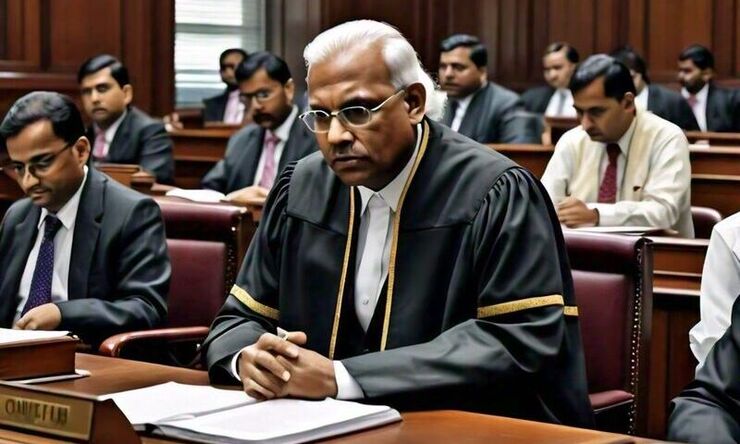
Representational Image of a Courtroom Created with Meta AI Image Generator

Recommendations to Restore the Credibility of the Indian Judiciary

Representational Image of a Courtroom Created with Meta AI Image Generator

Recommendations to Restore the Credibility of the Indian Judiciary

The excerpts from the “India Judicial Research Report 2024: Decline of the Indian Judiciary” are given below.

In order to restore the credibility of the Indian judiciary, some of the recommendations are given below.

Screening of Judges: The judges should not be appointed without proper live-streamed interviews with them by select committees of honest judges and reputed citizens after making the profiles and records of candidates public on a dedicated website. The open interviews with candidates should be on the lines of congressional hearings in the United States. This method should be applied to the existing judges also. Only those judges should be appointed in high courts and the Supreme Court who would not take government jobs or any other undue benefit after retirement.

Qualification of Lawyers: Only those people should be allowed to operate as advocates in courts who have obtained their law degrees from top colleges or universities. They should first clear a proper test comprising English, communications, law, technology, etc. before allocating a court to them. Their record and the fee they charge should be publicly available on a government-monitored website.

Lateral Entry: The courts can provide lateral entry to qualified professionals and domain experts to work as lawyers. Such lateral entry is already being provided in Indian civil services where professionals from the private sector are allowed to work as Indian Administrative Service (IAS), Indian Police Service (IPS), and Indian Revenue Service (IRS) officers.

Academic Courses: The law colleges and universities should revamp their courses and pedagogical methodologies to produce professionals who can work in the evolving legal ecosystem driven by new technologies and communication systems.

Formation of Juries: Since at present, the judges and lawyers are not fully qualified, there should be a mandatory provision to form independent juries to deliver the final verdict in certain types of cases. A jury is a group of qualified people who participate in a court trial to decide if a person is guilty or not guilty, or to decide a claim.

Technology for Judgments: In order to minimize the human intervention in the process of court decisions, artificial intelligence (AI)-based technology expert systems should be deployed in each court to evaluate the correctness of judgments. The litigants should be given the option to use the AI expert systems to get the court decisions vetted. Action should be taken against judges whose judgments fail the AI test repeatedly.

Legal Aid: It should be made compulsory for fully qualified advocates to provide free legal aid in all types of courts. These advocates must be selected after properly testing their communication skills, language skills, technology skills, and knowledge of law. There should be a proper mechanism for clients to complain against the dishonest or unskilled advocates.

Online Court Cases: At present, the e-filing systems are almost extinct. The digital interfaces to accept and manage court cases must be simplified so that more litigants can use them without hiring the services of advocates. Since the free email services such as Gmail, Hotmail, and Yahoo Mail are behaving erratically, the litigants should be given the option to simply upload their documents on all court websites with acknowledgement sent back to the litigant. 

Courage of Judges: All judges should work courageously without any fear of the criminal politicians. They should get inspired from judge Loya who died in mysterious circumstances, but many believe that he was murdered because he did not succumb to threats from certain politicians who were facing criminal cases.

Committee of Domain Experts: Instead of forming committees of traditional bureaucrats or court staff to supervise various legal processes, the Supreme Court and the government should form a top-level committee of domain experts who understand law, technology, communications, and public relations. This group of experts should redevelop and revamp the court processes.

You can click here to know more about the “India Judicial Research Report 2024: Decline of the Indian Judiciary”.

Contact

Rakesh Raman
Editor, RMN News Service [ Website ]
Founder, RMN Foundation [ Website ]
463, DPS Apts., Plot No. 16, Sector 4
Dwarka, Phase I, New Delhi 110 078, India
WhatsApp / Mobile: 9810319059 | Contact by Email

Donation: Indian donors can click here to donate online to RMN Foundation / RMN News Service and you can also click here to donate with PayPal.

Representational Image of a Courtroom Created with Meta AI Image Generator

Why Most Court Judgments in India Are Flawed

Why Most Court Judgments in India Are Flawed. Representational Image of a Courtroom Created with Meta AI Image Generator.

Why Most Court Judgments in India Are Flawed

The excerpts from the “India Judicial Research Report 2024: Decline of the Indian Judiciary” are given below.

While the members of the judiciary are not quite qualified, the government is blindly increasing the number of courts and judges. 

A large number of lawyers and judges are not comfortable in the use of English in courts. While most judges are not quite educated, there are numerous flaws in their written judgements as well as spoken pronouncements. 

Similarly, most lawyers are so ignorant that they cannot write even a few sentences correctly in English language, which is commonly used in Indian courts. According to the Department of Justice, Government of India, Article 348(1) of the Constitution of India provides that “all proceedings in the Supreme Court and in every high court shall be in English language until Parliament by law otherwise provides.”

But there is scarce use of proper English in courts. As India ranks 134 out of 193 countries and territories on the 2023/24 Human Development Index (HDI), the performance of workers in all the professional fields is bad. The same is visible in the judicial profession where judges as well as lawyers lack skills to work effectively and deliver proper justice to the citizens.

RELATED REPORTS

[ India Judicial Research Report 2024 Released ]

[ India Judicial Research Report 2024: Decline of the Indian Judiciary ]

[ Negligible Use of Technology in Indian Courts: Research Report on Indian Judiciary ]

[ How Indian Judiciary Is Condemned in the World ]

[ Indian Judiciary Research Report: Professional Incompetence of Lawyers and Judges ]

The members of the Indian judiciary are not able to work properly because they do not understand English which propels the modern information-driven world. Therefore, they keep working as manual workers because of which litigants suffer as they cannot challenge wrong court decisions.

It is being observed that almost all the court judgements and other documents which are used as part of the judicial work in India are flawed. Some of the examples of these wrong judgements and incorrect use of language are included in the research report, “Risks of English Language Limitations in Indian Judiciary: Pitfalls and Solutions”. [ You can click here to download and read the full research report. ]

While the members of the judiciary are not quite qualified, the government is blindly increasing the number of courts and judges. The 2023 data shared in the Rajya Sabha by the Department of Justice, Ministry of Law & Justice, Government of India, reveals that in the 686 districts of India, there are 3,466 district court complexes which accommodate over 2 million advocates. In addition, 25 high courts and the Supreme Court are supposed to handle millions of court cases filed every year.

For the year 2023, for example, nearly 2.6 crore (26 million) new cases were instituted across various levels of courts. These include civil, criminal, and other types of cases at the Supreme Court, high courts, and subordinate courts. Since the number of judges in courts is pathetically low, they are not able to deliver proper justice to litigants.

Download: You can click here to download and read the India Judicial Research Report 2024 to support this editorial initiative.

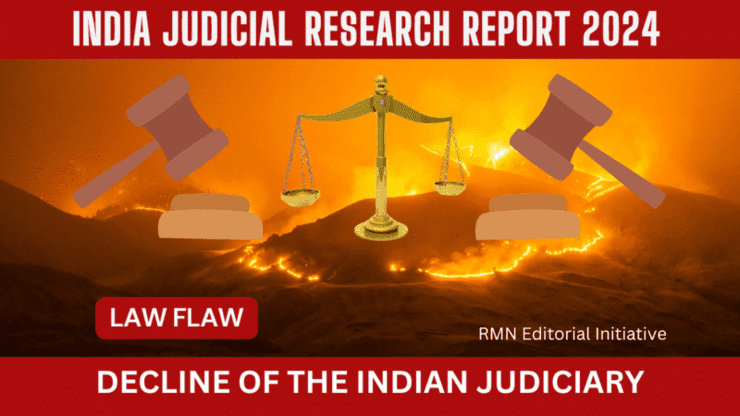
India Judicial Research Report 2024. Decline of the Indian Judiciary. Photo: RMN News Service

India Judicial Research Report 2024: Decline of the Indian Judiciary

India Judicial Research Report 2024. Decline of the Indian Judiciary. Photo: RMN News Service

India Judicial Research Report 2024: Decline of the Indian Judiciary

The report also analyzes the obsolete syllabuses in law colleges and universities which are not producing employable workforce for the Indian courts. 

The India Judicial Research Report 2024 discusses various factors that are responsible for the downfall of the Indian judiciary and the impact of this constant collapse on the litigants particularly who belong to the vulnerable sections of the society. 

With the help of some specific court cases, the report sheds light on the dwindling judicial processes in India, scarce use of technology, flawed application of law, judicial corruption, limited domain knowledge of lawyers and judges, and their lack of English communication skills.

The information for the report has been taken from primary as well as secondary sources. It also includes some of the editor’s personal experiences of dealing with the judiciary. The hyperlinks included in this digital document provide detailed information about the specific aspects of various assertions.

The report also analyzes the obsolete syllabuses in law colleges and universities which are not producing employable workforce for the Indian courts. As a result of its dismal performance, the Indian judiciary is treated with disdain in the global arena which is reflected in research reports that rank different countries of the world. 

Now, it appears that because of dishonest – and mostly naive – lawyers and judges, nearly 1.4 billion people of India have lost faith in the courts and their judgements. Thus, the judiciary has become one of the most redundant institutions in the country.

The report also makes some recommendations for the Supreme Court, the Indian government, and law institutes so that the entire judicial system in the country could be reformed and revamped.

The author / editor of this report Rakesh Raman is a national award-winning journalist and founder of the humanitarian organization RMN Foundation in New Delhi, India.

Donation: Indian donors can click here to donate online to RMN Foundation / RMN News Service and you can also click here to donate with PayPal.

Download: You can click here to download and read the India Judicial Research Report 2024 to support this editorial initiative.

Contact

Rakesh Raman
Editor, RMN News Service [ Website ]
Founder, RMN Foundation [ Website ]
463, DPS Apts., Plot No. 16, Sector 4
Dwarka, Phase I, New Delhi 110 078, India
WhatsApp / Mobile: 9810319059 | Contact by Email