The Secret Rulebook: Understanding Corruption in Delhi’s Housing Societies
The corruption is guaranteed to continue because the official channels for accountability and justice have effectively collapsed. Residents who try to fight back find themselves trapped in a system that is either indifferent, corrupt, or actively working against them.
By Rakesh Raman
New Delhi | January 12, 2026
Introduction: The Broken Promise of Community Living
A cooperative housing society is supposed to be a community built on shared responsibility and mutual benefit. It’s an idea that promises residents a secure, harmonious, and well-managed place to live. However, for millions of people in Delhi, this promise has been broken. Their communities have become centers of crime, widespread corruption, and systemic harassment.
This document explains why this is happening by focusing on one central problem: a deliberate and calculated lack of transparency. We will explore how a simple rule designed to ensure honesty has been systematically ignored, creating a hidden world where corruption is allowed to thrive.
1. The Simple Rule That Was Meant to Keep Things Honest
Every housing society is run by an elected group of residents called a Management Committee (MC). To prevent these committees from becoming corrupt, the Delhi Government’s Registrar Cooperative Societies (RCS) office created a simple but powerful solution: every single society must have a transparent, regularly updated website.
This rule has been official policy since at least 2015 and has been reinforced multiple times. Complying with this rule has almost no cost, as free software and platforms are widely available. The goal was to empower residents with information and hold their elected MCs accountable.
What Every Society Website Must Show
The RCS directives are supposed to ensure that a society’s information must be publicly available and kept up-to-date. The information may include:
- Details of all members of the society.
- Complete records of all financial transactions, including purchase documents and vouchers.
- Details of all contracts and the criteria used for the appointment of vendors.
- Regular updates on the status of all legal cases involving the society.
- An online form for members to register complaints and an official email for communication.
- A complete record of all internal and external communications.
- Instant and regular updates of all communications between members and the MC, ensuring a real-time record of interactions.
This clear rule was designed to be a straightforward tool for honesty. However, the reality on the ground reveals a massive gap between this policy and what is actually happening.
2. A Rule Ignored: The Widespread Defiance
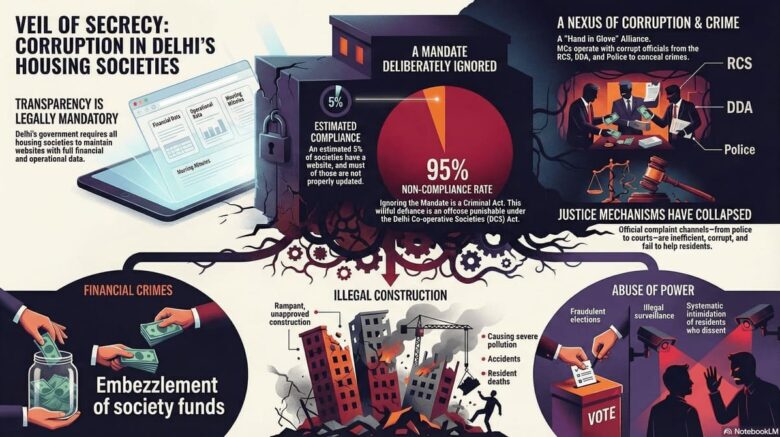
The scale of the problem is staggering. An estimated 95% of housing societies in Delhi do not have a website. Of the mere 5% that do, most are useless because they are never updated with the required information.
According to the investigative report, this isn’t a simple oversight or a technical challenge. It is described as a “willful defiance” and a “blatant ignoring” of a legally binding government order. The law is clear on this point:
Failing to establish and maintain an updated website is legally considered an “offence” and a “criminal act”. The MC members responsible can be prosecuted under the Delhi Co-operative Societies (DCS) Act and relevant sections of the Indian Penal Code (or its successor, the Bharatiya Nyaya Sanhita, 2023).
This exposes a critical question: How do so many Management Committees get away with openly breaking the law?
3. The Secret Partnership: How Corruption is Protected
The primary reason this defiance is so widespread is a corrupt partnership where Management Committees operate “hand in glove” with government officials. This secret alliance creates a protective shield, allowing MCs to ignore the law without any fear of consequences.
This network of complicity extends across multiple government bodies, each playing a role in protecting corrupt MCs.
The Network of Complicity
| Government Body | How They Help Corrupt MCs |
| Registrar Cooperative Societies (RCS) | Allegedly accepts bribes to ignore non-compliance with the website rule and closes resident complaint cases without taking any real action. |
| Delhi Development Authority (DDA) | Supports corrupt MCs in illegal activities, particularly unauthorized construction projects. |
| Delhi Police | Described as “perhaps the most corrupt police force in the country”; consistently fails to take action against MCs and has been accused of deliberately omitting their names from official reports (FIRs) for serious crimes. |
| Municipal Corporation of Delhi (MCD) | Implicated in the network of connivance, further enabling illegal activities. |
| Other Delhi Govt. Departments | This includes the Delhi Jal Board (DJB), Delhi Fire Service (DFS), and Delhi Pollution Control Committee (DPCC), expanding the protective shield. |
| Ruling Politicians | Allegedly receive a share of the bribe money collected by departments, ensuring they turn a blind eye to the widespread corruption. |
This network ensures that the very system designed to regulate housing societies is instead used to protect criminal activity. This official protection allows a range of harmful and illegal acts to flourish within these communities.
4. The Real-World Harm: What Happens When No One is Watching
This deliberate secrecy is not a victimless crime. It directly enables criminal activities that harm residents, violate their rights, and damage their communities both financially and physically.
Financial Crime
Without transparent records, MCs can easily misuse society funds. Key examples include:
- Swindling society funds through large, expensive projects where costs can be inflated and money embezzled.
- Illicitly selling car parking spaces to residents in exchange for substantial bribes.
- Allowing society staff, such as plumbers and electricians, to “fleece the residents by charging heavy amounts even for small tasks,” likely while taking illicit commissions.
Dangerous Construction
The lack of oversight allows illegal Floor Area Ratio (FAR) construction to run as a massive “extortion racket.”
- This activity subjects thousands of residents, including children and the elderly, to severe and prolonged noise and dust pollution.
- This unauthorized construction often leads to serious and even fatal accidents, all while generating illegal profits for the MCs and their official partners.
Abuse of Power
Unchecked by any real oversight, MCs can abuse their authority and violate the human rights of residents.
- They hold fraudulent elections to stay in power, with the same members often rotating posts for decades.
- They intimidate residents who dare to complain or ask questions.
- They allow nuisances that degrade the quality of life, such as tolerating “ferocious dogs” that disturb residents or allowing constant, disruptive construction that turns buildings into “war-torn regions.”
When residents try to seek help from the authorities to stop these abuses, they discover that the systems designed to protect them are completely broken.
5. A System of Failure: Why Getting Help is Nearly Impossible
The corruption is guaranteed to continue because the official channels for accountability and justice have effectively collapsed. Residents who try to fight back find themselves trapped in a system that is either indifferent, corrupt, or actively working against them.
An analysis of the four main channels for recourse reveals a consistent pattern of failure:
1. RCS Inquiries: These are described as “perfunctory” or superficial. The RCS may send a notice, but cases are routinely closed without providing any relief to the resident, allegedly because officials are bribed by the MCs.
2. The Courts: The judicial system is “overcrowded” and “inefficient.” This means that even if a resident goes to court, they face extremely long delays and often receive unjust decisions, making it an unworkable option for most.
3. Online Grievance Portals: Government portals are often managed by the same corrupt officials who are part of the problem. As a result, complaints are closed without any meaningful action being taken.
4. The Delhi Police: The police force consistently fails to act on complaints. In cases of serious crimes, such as deaths from illegal construction, they have been accused of deliberately removing the names of the responsible MC members from official reports.
This total system failure leaves residents with virtually no official way to fight back against the corruption and abuse they face.
6. A Call for Real Change
The problems in Delhi’s housing societies are not just isolated incidents of mismanagement. They are the direct result of a deliberate, systemic, and corrupt ecosystem built on a foundation of secrecy. The failure to enforce one simple rule—the mandatory website—has enabled a criminal alliance between Management Committees and government officials to flourish, turning communities into personal fiefdoms.
The source report goes so far as to describe Delhi as the “corruption capital of India,” highlighting that this issue is part of a much larger crisis of governance. To restore the rights of millions of residents and reclaim the promise of cooperative living, fundamental reforms are needed. The two most critical and immediate actions are:
- Prosecuting non-compliant MC members to enforce the law and create genuine accountability.
- A complete and transparent revamp of the corrupt RCS office to break the cycle of complicity.
The source report argues that given the scale of the crisis, more drastic measures are necessary to break the criminal enterprise:
- A call for a “separate jail” to be built specifically for corrupt MC members and the bureaucrats who enable them.
- The need for intervention from international human rights and law-enforcement agencies, given the “categorical failure of India’s judicial forums to provide justice.”
Top Image: Understanding Corruption in Delhi’s Housing Societies | RMN Foundation Report
By Rakesh Raman, who is a national award-winning journalist and social activist. He is the founder of a humanitarian organization RMN Foundation which is working in diverse areas to help the disadvantaged and distressed people in the society.
He has been running for the past 8 years a community-driven anti-corruption social service “Clean House” to help the residents of Delhi who are victims of crime and corruption committed by the management committees (MCs) of Delhi’s Cooperative Group Housing Societies (CGHS).
Donation to RMN Foundation