Archive: January 26, 2026

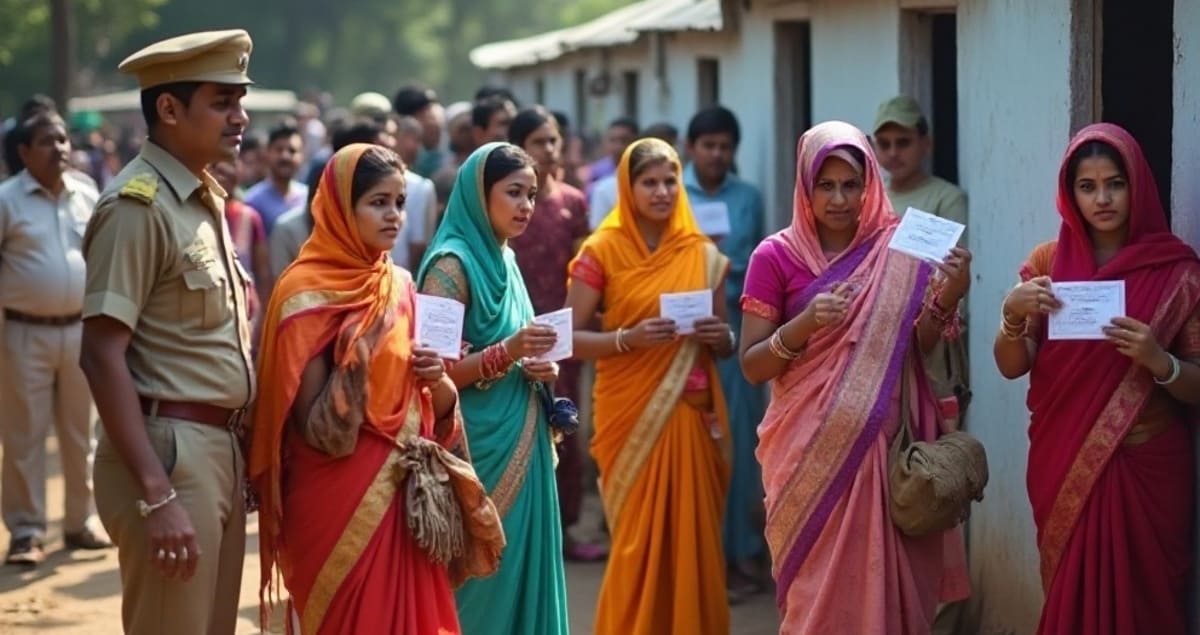
Smokescreen Report. AI-generated representational image of men and women standing outside a polling booth to vote in an Indian election. Photo: RMN News Service

The Smokescreen 2026: Voting Without Verification and the Collapse of Electoral Accountability in India

Smokescreen Report. AI-generated representational image of men and women standing outside a polling booth to vote in an Indian election. Photo: RMN News Service

The Smokescreen 2026: Voting Without Verification and the Collapse of Electoral Accountability in India

Democracy does not die only through coups or emergency declarations. It can also die quietly—through procedures that look lawful, elections that look competitive, and institutions that look independent, while collectively ensuring that outcomes are never meaningfully questioned.

By Rakesh Raman
New Delhi | January 26, 2026

India is routinely described as the world’s largest democracy. Yet, beneath the spectacle of record voter turnout, election festivals, and official slogans celebrating democratic participation, a deeper and more troubling reality has taken hold: Indian citizens are increasingly asked to vote without any credible means to verify where their vote ultimately goes.

The Smokescreen 2026 report documents how India’s electoral system has evolved into a managed illusion of democracy, sustained through Electronic Voting Machines (EVMs), institutional capture, and the systematic erosion of oversight mechanisms that once safeguarded electoral integrity.

Voting Rights Without the Right to Verification

The right to vote is not merely the act of pressing a button on polling day. It includes the right to transparency, auditability, and post-election verification. In India, this core democratic principle has been hollowed out.

Despite repeated public concerns, expert critiques, and legal challenges, Indian voters remain unable to independently verify whether their vote has been accurately recorded, counted, and reflected in final results. The limited VVPAT system, often cited as a safeguard, functions largely as a symbolic reassurance rather than a genuine audit mechanism. There is no statistically meaningful, voter-verifiable, or citizen-controlled audit of election outcomes.

A democracy that asks citizens to trust blindly—without verifiable proof—ceases to be a democracy in substance, regardless of how frequently elections are held.

🔊 द स्मोकस्क्रीन: भारतीय लोकतंत्र का प्रबंधित भ्रम: ऑडियो विश्लेषण ]

Electronic Voting Machines and Electoral Opacity

EVMs were introduced to prevent booth capturing and electoral fraud. Instead, over time, they have become the central source of electoral opacity.

The Smokescreen report does not rely on conjecture or partisan narratives. It compiles documented anomalies, procedural contradictions, judicial evasions, and the Election Commission of India’s consistent refusal to allow independent, transparent audits of EVMs. When institutions tasked with administering elections resist scrutiny rather than welcome it, democratic confidence erodes by design.

In any mature democracy, electoral technology is subjected to adversarial testing, independent certification, and public verification. In India, the opposite model prevails: secrecy, institutional defensiveness, and legal stonewalling.

Institutional Capture and the Failure of Domestic Remedies

A functioning democracy depends on institutional checks and balances. The Smokescreen report establishes that these safeguards in India have largely collapsed.

  • The Election Commission of India (ECI) increasingly operates as an executive-aligned administrator rather than an independent constitutional authority.

  • The judiciary, once seen as the last institutional refuge for citizens, has repeatedly avoided substantive adjudication on electoral transparency, often deferring to executive assurances without scrutiny.

  • Investigative agencies are selectively deployed, weakening the opposition while insulating the ruling establishment.

  • Parliamentary opposition, fragmented and risk-averse, has failed to mount sustained institutional or street-level resistance to systemic electoral concerns.

This convergence has created a closed loop of power where electoral outcomes reinforce institutional capture, and institutional capture ensures electoral outcomes.

Why International Supervision Has Become Necessary

International election observation is typically associated with fragile or transitional democracies. India was once a model that provided observers elsewhere. That moral authority has now been forfeited.

When domestic institutions fail simultaneously—when courts do not adjudicate, election bodies do not audit, and political opposition does not challenge—international democratic oversight becomes not interference, but necessity.

The call for international supervision is not a demand for external control. It is a request for neutral, professional, and transparent observation, aligned with global democratic norms that India itself has historically endorsed.

From Electoral Ritual to Democratic Reality

India today performs democracy exceptionally well. What it no longer guarantees is democratic accountability.

Celebrations like National Voters’ Day, grand election campaigns, and official proclamations about democratic duty ring hollow when citizens are denied the most basic democratic right: the ability to know whether their vote truly counts.

The Smokescreen 2026 report is a public-interest intervention aimed at restoring that right. It documents how electoral opacity, institutional capture, and manufactured consent have replaced transparency, accountability, and popular sovereignty.

Democracy does not die only through coups or emergency declarations. It can also die quietly—through procedures that look lawful, elections that look competitive, and institutions that look independent, while collectively ensuring that outcomes are never meaningfully questioned.

India now stands at that threshold.
By Rakesh Raman, who is a national award-winning journalist and social activist. He is the founder of a humanitarian organization RMN Foundation which is working in diverse areas to help the disadvantaged and distressed people in the society.

Top Image: AI-generated representational image of men and women standing outside a polling booth to vote in an Indian election. Photo: RMN News Service
Understanding Corruption in Delhi's Housing Societies | RMN Foundation Report

The Secret Rulebook: Understanding Corruption in Delhi’s Housing Societies

Understanding Corruption in Delhi's Housing Societies | RMN Foundation Report

The Secret Rulebook: Understanding Corruption in Delhi’s Housing Societies

The corruption is guaranteed to continue because the official channels for accountability and justice have effectively collapsed. Residents who try to fight back find themselves trapped in a system that is either indifferent, corrupt, or actively working against them.

By Rakesh Raman
New Delhi | January 12, 2026

Introduction: The Broken Promise of Community Living

A cooperative housing society is supposed to be a community built on shared responsibility and mutual benefit. It’s an idea that promises residents a secure, harmonious, and well-managed place to live. However, for millions of people in Delhi, this promise has been broken. Their communities have become centers of crime, widespread corruption, and systemic harassment.

This document explains why this is happening by focusing on one central problem: a deliberate and calculated lack of transparency. We will explore how a simple rule designed to ensure honesty has been systematically ignored, creating a hidden world where corruption is allowed to thrive.

1. The Simple Rule That Was Meant to Keep Things Honest

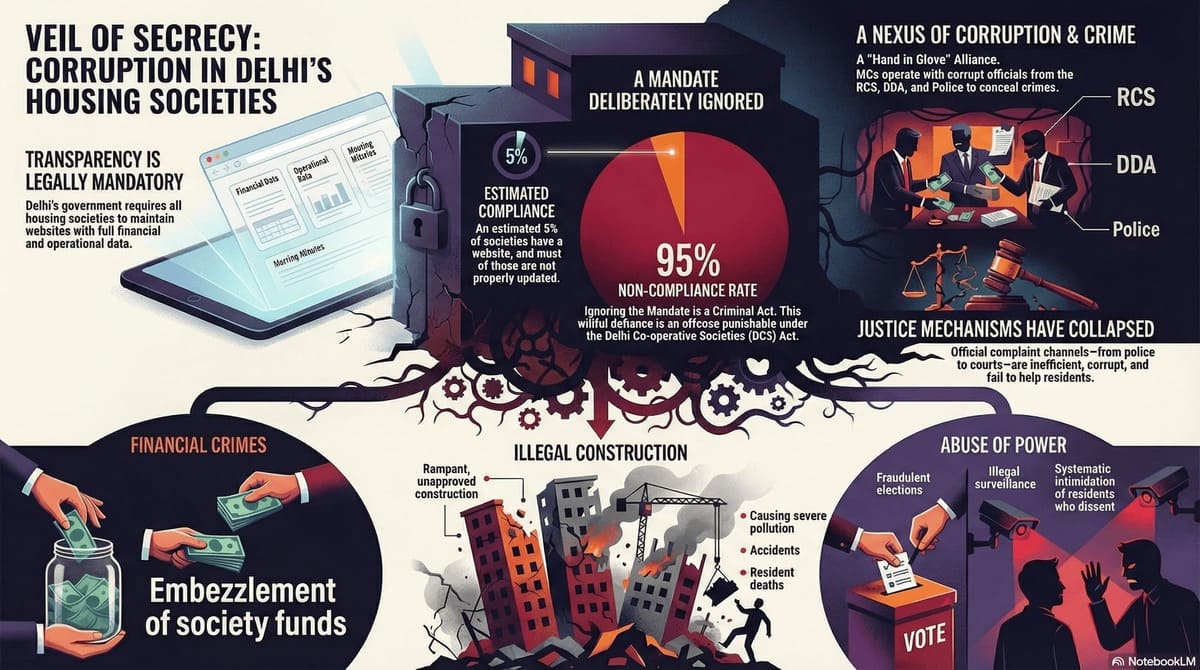
Every housing society is run by an elected group of residents called a Management Committee (MC). To prevent these committees from becoming corrupt, the Delhi Government’s Registrar Cooperative Societies (RCS) office created a simple but powerful solution: every single society must have a transparent, regularly updated website.

This rule has been official policy since at least 2015 and has been reinforced multiple times. Complying with this rule has almost no cost, as free software and platforms are widely available. The goal was to empower residents with information and hold their elected MCs accountable.

What Every Society Website Must Show

The RCS directives are supposed to ensure that a society’s information must be publicly available and kept up-to-date. The information may include:

  • Details of all members of the society.
  • Complete records of all financial transactions, including purchase documents and vouchers.
  • Details of all contracts and the criteria used for the appointment of vendors.
  • Regular updates on the status of all legal cases involving the society.
  • An online form for members to register complaints and an official email for communication.
  • A complete record of all internal and external communications.
  • Instant and regular updates of all communications between members and the MC, ensuring a real-time record of interactions.

This clear rule was designed to be a straightforward tool for honesty. However, the reality on the ground reveals a massive gap between this policy and what is actually happening.

2. A Rule Ignored: The Widespread Defiance

The scale of the problem is staggering. An estimated 95% of housing societies in Delhi do not have a website. Of the mere 5% that do, most are useless because they are never updated with the required information.

According to the investigative report, this isn’t a simple oversight or a technical challenge. It is described as a “willful defiance” and a “blatant ignoring” of a legally binding government order. The law is clear on this point:

Failing to establish and maintain an updated website is legally considered an “offence” and a “criminal act”. The MC members responsible can be prosecuted under the Delhi Co-operative Societies (DCS) Act and relevant sections of the Indian Penal Code (or its successor, the Bharatiya Nyaya Sanhita, 2023).

This exposes a critical question: How do so many Management Committees get away with openly breaking the law?

3. The Secret Partnership: How Corruption is Protected

The primary reason this defiance is so widespread is a corrupt partnership where Management Committees operate “hand in glove” with government officials. This secret alliance creates a protective shield, allowing MCs to ignore the law without any fear of consequences.

This network of complicity extends across multiple government bodies, each playing a role in protecting corrupt MCs.

The Network of Complicity

Government Body How They Help Corrupt MCs
Registrar Cooperative Societies (RCS) Allegedly accepts bribes to ignore non-compliance with the website rule and closes resident complaint cases without taking any real action.
Delhi Development Authority (DDA) Supports corrupt MCs in illegal activities, particularly unauthorized construction projects.
Delhi Police Described as “perhaps the most corrupt police force in the country”; consistently fails to take action against MCs and has been accused of deliberately omitting their names from official reports (FIRs) for serious crimes.
Municipal Corporation of Delhi (MCD) Implicated in the network of connivance, further enabling illegal activities.
Other Delhi Govt. Departments This includes the Delhi Jal Board (DJB), Delhi Fire Service (DFS), and Delhi Pollution Control Committee (DPCC), expanding the protective shield.
Ruling Politicians Allegedly receive a share of the bribe money collected by departments, ensuring they turn a blind eye to the widespread corruption.

This network ensures that the very system designed to regulate housing societies is instead used to protect criminal activity. This official protection allows a range of harmful and illegal acts to flourish within these communities.

4. The Real-World Harm: What Happens When No One is Watching

This deliberate secrecy is not a victimless crime. It directly enables criminal activities that harm residents, violate their rights, and damage their communities both financially and physically.

Financial Crime

Without transparent records, MCs can easily misuse society funds. Key examples include:

  • Swindling society funds through large, expensive projects where costs can be inflated and money embezzled.
  • Illicitly selling car parking spaces to residents in exchange for substantial bribes.
  • Allowing society staff, such as plumbers and electricians, to “fleece the residents by charging heavy amounts even for small tasks,” likely while taking illicit commissions.

Dangerous Construction

The lack of oversight allows illegal Floor Area Ratio (FAR) construction to run as a massive “extortion racket.”

  • This activity subjects thousands of residents, including children and the elderly, to severe and prolonged noise and dust pollution.
  • This unauthorized construction often leads to serious and even fatal accidents, all while generating illegal profits for the MCs and their official partners.

Abuse of Power

Unchecked by any real oversight, MCs can abuse their authority and violate the human rights of residents.

  • They hold fraudulent elections to stay in power, with the same members often rotating posts for decades.
  • They intimidate residents who dare to complain or ask questions.
  • They allow nuisances that degrade the quality of life, such as tolerating “ferocious dogs” that disturb residents or allowing constant, disruptive construction that turns buildings into “war-torn regions.”

When residents try to seek help from the authorities to stop these abuses, they discover that the systems designed to protect them are completely broken.

5. A System of Failure: Why Getting Help is Nearly Impossible

The corruption is guaranteed to continue because the official channels for accountability and justice have effectively collapsed. Residents who try to fight back find themselves trapped in a system that is either indifferent, corrupt, or actively working against them.

An analysis of the four main channels for recourse reveals a consistent pattern of failure:

1. RCS Inquiries: These are described as “perfunctory” or superficial. The RCS may send a notice, but cases are routinely closed without providing any relief to the resident, allegedly because officials are bribed by the MCs.

2. The Courts: The judicial system is “overcrowded” and “inefficient.” This means that even if a resident goes to court, they face extremely long delays and often receive unjust decisions, making it an unworkable option for most.

3. Online Grievance Portals: Government portals are often managed by the same corrupt officials who are part of the problem. As a result, complaints are closed without any meaningful action being taken.

4. The Delhi Police: The police force consistently fails to act on complaints. In cases of serious crimes, such as deaths from illegal construction, they have been accused of deliberately removing the names of the responsible MC members from official reports.

This total system failure leaves residents with virtually no official way to fight back against the corruption and abuse they face.

6. A Call for Real Change

The problems in Delhi’s housing societies are not just isolated incidents of mismanagement. They are the direct result of a deliberate, systemic, and corrupt ecosystem built on a foundation of secrecy. The failure to enforce one simple rule—the mandatory website—has enabled a criminal alliance between Management Committees and government officials to flourish, turning communities into personal fiefdoms.

The source report goes so far as to describe Delhi as the “corruption capital of India,” highlighting that this issue is part of a much larger crisis of governance. To restore the rights of millions of residents and reclaim the promise of cooperative living, fundamental reforms are needed. The two most critical and immediate actions are:

  • Prosecuting non-compliant MC members to enforce the law and create genuine accountability.
  • A complete and transparent revamp of the corrupt RCS office to break the cycle of complicity.

The source report argues that given the scale of the crisis, more drastic measures are necessary to break the criminal enterprise:

  • A call for a “separate jail” to be built specifically for corrupt MC members and the bureaucrats who enable them.
  • The need for intervention from international human rights and law-enforcement agencies, given the “categorical failure of India’s judicial forums to provide justice.”

Top Image: Understanding Corruption in Delhi’s Housing Societies | RMN Foundation Report

By Rakesh Raman, who is a national award-winning journalist and social activist. He is the founder of a humanitarian organization RMN Foundation which is working in diverse areas to help the disadvantaged and distressed people in the society.

He has been running for the past 8 years a community-driven anti-corruption social service “Clean House” to help the residents of Delhi who are victims of crime and corruption committed by the management committees (MCs) of Delhi’s Cooperative Group Housing Societies (CGHS). 

Unnao Rape Case Legal Reversal: The Supreme Court of India has stayed a Delhi High Court order that previously granted bail to former BJP MLA Kuldeep Singh Sengar.

Connecting the Dots: Key Themes from “The Unrest”

Unnao Rape Case Legal Reversal: The Supreme Court of India has stayed a Delhi High Court order that previously granted bail to former BJP MLA Kuldeep Singh Sengar.

Connecting the Dots: Key Themes from “The Unrest”

Unnao Rape Case Legal Reversal: The Supreme Court of India has stayed a Delhi High Court order that previously granted bail to former BJP MLA Kuldeep Singh Sengar.

1. Introduction: Understanding a World of “Unrest”

Welcome to a deeper analysis of the global landscape. This summary synthesizes the major news stories from the January 1-15, 2026 issue of the RMN news magazine, “The Unrest.” While individual headlines about protests, technological breakthroughs, and legal battles can seem disconnected, they often point to larger, underlying global currents. The goal of this document is to connect these seemingly separate events under three powerful themes that emerge from the magazine’s coverage: widespread political and social instability, the dual-edged nature of technology, and a growing fight for truth and justice. We begin by exploring the first and most prominent theme: a world in a state of upheaval.

2. Theme 1: A World in Upheaval – Political & Social Unrest

Across the globe, numerous societies are grappling with significant internal and external conflicts. The magazine’s coverage highlights a pattern of citizen-led protests, challenges to government authority, and escalating diplomatic tensions.

The following table summarizes the domestic challenges reported in three key nations:

Country Nature of Unrest Key Detail
India Challenges to ruling party and democratic integrity Linked to a systemic corruption crisis and “democratic backsliding.”
Bangladesh Massive national protests Erupted after activist Sharif Osman Hadi died from injuries sustained in an assassination attempt.
Iran Anti-government demonstrations Fueled by skyrocketing inflation and the devaluation of the national currency.

Beyond internal struggles, the magazine highlights how international conflicts are increasingly fought not with armies alone, but through narratives, accusations, and the strategic control of information. Truth itself has become a contested territory, as seen in two major diplomatic disputes. A major diplomatic rift has opened between Russia and Ukraine after Moscow alleged that Kyiv launched a drone attack on one of President Putin’s residences—a claim Kyiv dismisses as “Typical Lies.” This incident showcases how modern conflicts are fought not just on the battlefield but in the media, with truth itself becoming a casualty.

Similarly, a geopolitical firestorm has erupted between India and China over the film Battle of Galwan. Chinese state media accuses the film of distorting historical facts, while the Indian government defends it as an act of artistic freedom. Here, a cultural product becomes a proxy for a larger national and historical dispute, illustrating how media and art are increasingly weaponized in geopolitical confrontations.

This landscape of conflict, both domestic and international, is increasingly shaped and amplified by modern tools, leading us to the second major theme: the profound and often contradictory role of technology.

3. Theme 2: The Double-Edged Sword – Technology’s Impact on Society

The articles in “The Unrest” present technology as a powerful force with both immense potential for progress and a significant capacity for harm. It is simultaneously a tool for empowerment and a source of anxiety, creating a complex and often contradictory picture of our digital age.

The Promise of Technology

  • Empowering Businesses and Citizens: Technology is showcased as a key driver of opportunity and education. A “Beginner’s Guide” explains how small businesses can leverage Artificial Intelligence (AI) for social media marketing. This democratizes powerful marketing capabilities, allowing small enterprises to compete with larger corporations on a more level playing field. In a similar vein, the partnership between the Council of Europe and Google to advance digital citizenship education aims to equip the next generation with the critical thinking skills needed to combat misinformation and participate constructively in a digital society.
  • Driving Sustainable Change: Technology is also a crucial element in creating a more sustainable future. The BAFTA albert initiative, supported by industry giants like the BBC, Netflix, ITV, and Sky, is using technology to promote “Fossil Fuel-Free Production” in the film and TV industry, demonstrating its power to drive positive environmental change at a systemic level.

The Peril of Technology

Simultaneously, technology’s relentless push for automation fuels deep-seated anxieties, posing a dual threat to both economic security and personal autonomy. In the creative industries, Google’s new AI filmmaking tools spark fears of mass job displacement for roles from directors to writers. In consumer finance, ICICI Bank’s digital systems are shown to create “automated harassment,” demonstrating how the pursuit of efficiency can erode both professional livelihoods and personal dignity. This distrust culminates in the political arena, where calls in India for a mass movement to abolish Electronic Voting Machines (EVMs) reveal how technological systems, when perceived as opaque or insecure, can undermine faith in democracy itself.

The disruptive power of technology—its ability to create and destroy, to clarify and confuse—naturally leads to our final theme: a fundamental struggle over the very concepts of truth, freedom, and justice.

4. Theme 3: Under Siege – The Fight for Freedom, Truth, and Justice

Several articles highlight a growing crisis of confidence in foundational societal pillars. From the courts to the media, institutions responsible for upholding justice and disseminating truth are facing intense scrutiny and, in some cases, are perceived as failing.

  1. Eroding Justice Systems: The Unnao rape case in India serves as a powerful example of this crisis. The Delhi High Court’s decision to grant bail to the convicted former politician Kuldeep Singh Sengar was widely seen as a “profound failure to deliver substantive justice.” The ruling ignited “widespread fury” and was quickly reversed by the Supreme Court, but the incident exposed deep vulnerabilities in the justice system and its ability to protect the powerless.
  2. Declining Freedom of Expression: This is not just a localized issue but a global trend. A flagship report from UNESCO delivers a startling statistic: a “historic 10% decline in global freedom of expression between 2012 and 2024.” This erosion, depicted visually in the magazine with an image titled “ATTACK ON PRESS FREEDOM,” signals a worldwide threat to the ability of journalists and citizens to speak freely and hold power to account.
  3. A Crisis of Credibility: Trust in key institutions appears to be at an all-time low. The report on Bollywood reveals a “severe credibility crisis” where “paid reviews and manipulated media narratives” have become the industry norm, corroding public trust in cultural products. This is mirrored in the political sphere, where the India Corruption Research Report 2025 exposes a “systemic ecosystem” of corruption that is directly linked to “democratic backsliding.” This parallel decay—in both cultural and political institutions—reveals a comprehensive erosion of public trust, where neither entertainment nor governance can be taken at face value.

These interconnected struggles for justice, freedom, and truth paint a complex and challenging picture of the current global landscape.

5. Conclusion: Synthesizing “The Unrest”

The January 1-15, 2026 issue of “The Unrest” does more than report on isolated events; it chronicles a world defined by interconnected trends. The stories weave together to reveal three core themes: a global surge in political and social instability, from street protests to diplomatic standoffs; the disruptive, dual nature of technology, which acts as both a catalyst for progress and a source of societal anxiety; and a critical fight to defend foundational values like justice, freedom, and truth from erosion. These themes suggest we are living in an era where foundational pillars of society are being fractured, forcing a global contest over the future of truth, power, and technological control.

Top Image: AI-generated image of women protesting in front of the Supreme Court | Photo: RMN News Service