Tag: Smokescreen

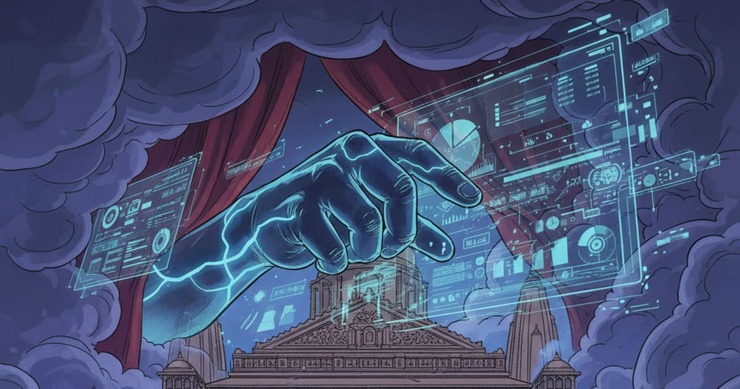
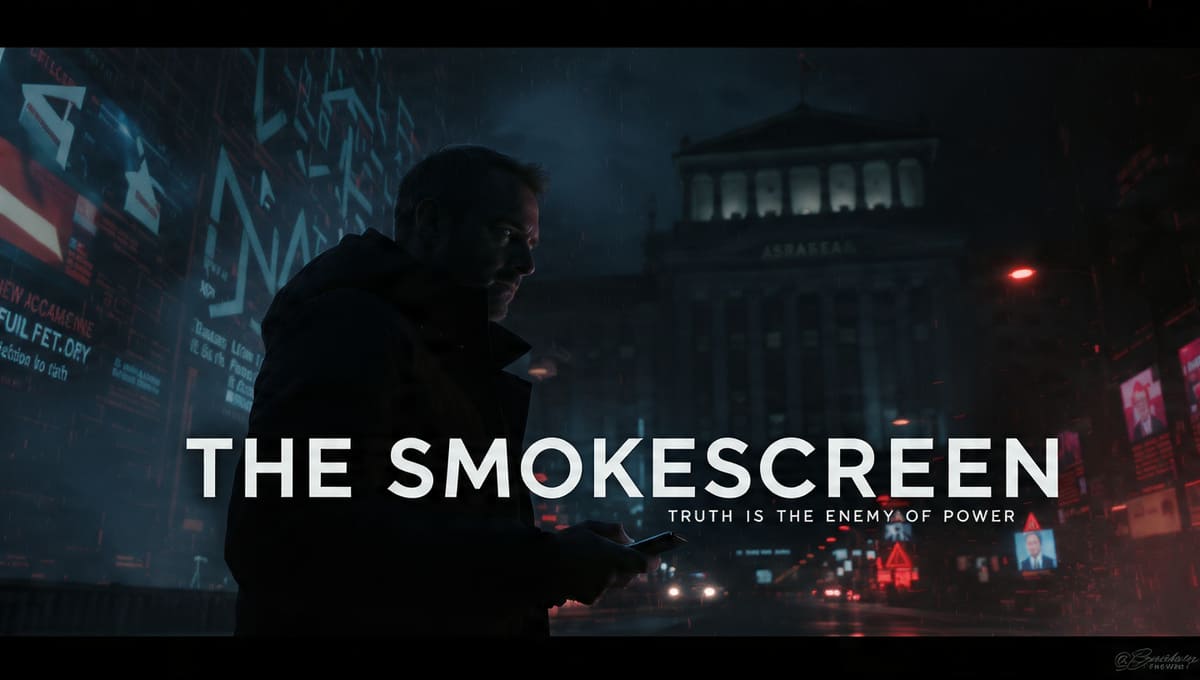
THE SMOKESCREEN — A High-Voltage Political Thriller Film Project by Rakesh Raman

Guide to Decoding Managed Illusions: Identifying Political Propaganda in Entertainment

THE SMOKESCREEN — A High-Voltage Political Thriller Film Project by Rakesh Raman

Guide to Decoding Managed Illusions: Identifying Political Propaganda in Entertainment

In an era of managed illusions, the ultimate democratic act is the ability to perceive the rhythmic fluctuations of power hidden behind the cinematic smokescreen.

By Rakesh Raman
New Delhi | February 17, 2026

1. Introduction: The Concept of the “Managed Illusion”

In the contemporary landscape of political communication, the traditional boundary between a functioning democracy and a carefully orchestrated performance has collapsed. To analyze this shift, we must employ the semiotic framework of the “managed illusion.” This term describes a state of institutional hollowing where the signifiers of democracy remain present while the underlying democratic substance has been extracted.

Definition: Managed Illusion: A “managed illusion” refers to a political environment where the aesthetic architecture of democracy—including elections, judicial proceedings, and a free press—is maintained as a facade to mask systemic institutional capture. In this state, public discourse is not a product of organic civic engagement but a scripted narrative managed by dominant political actors to manufacture consent and obscure authoritarian drift.

For the narrative analyst, identifying these illusions is a foundational necessity. When democratic processes are reduced to a performance, entertainment media becomes the primary stage for state-aligned messaging. Understanding this allows the citizen-viewer to transition from a state of passive consumption to one of critical decoding, distinguishing between legitimate storytelling and the “smokescreens” designed to protect entrenched power.

This analytical journey begins by examining how research-driven fiction can be weaponized to expose the very systems of control that traditional media fails to address.

2. Understanding the “Smokescreen” Film Project

To bypass the cognitive filters and partisan censorship inherent in legacy media, independent creators are utilizing “proxy narratives.” A primary example is the film project The Smokescreen. By situating its analysis within the fictional nation of Astraea, the project allows viewers to observe the mechanisms of the “Astraea Protocol”—a blueprint for systemic institutional capture—without the immediate affective interference of domestic political tribalism.

Fiction vs. Reality

Elements of the “Astraea” Narrative Corresponding Real-World Concerns (RMN News 2026 Report)
Institutional Capture: The methodical takeover of state agencies by a central political entity. Systematic Erosion of Indian Democracy: The hollowing out of democratic guardrails as documented in RMN News research.
The Astraea Protocol: A fictional operational manual for manipulating a nation’s destiny. EVM Manipulation: Documented irregularities in Electronic Voting Machines and the integrity of the 2026 electoral process.
Astraean Political Thriller: A narrative designed to expose structural corruption. Independent News Analysis: The RMN model of DOI-based, citable research used to counter narrative hegemony.

Key Insight: The tactical benefit of the Astraea setting lies in its ability to present high-level research on institutional hollowing through a semiotic proxy. This allows the audience to recognize patterns of authoritarianism—such as the manipulation of voting technologies—through a detached, analytical lens that would be otherwise obscured by the noise of legacy news cycles.

While research-driven fiction exposes the protocol, state-aligned cinema replicates it by leveraging affective narratives to bypass cognitive scrutiny.

3. Case Studies in Nationalist Cinema: Vengeance and Masking

Nationalist cinema serves as a primary tool for “affective displacement,” where complex political failures are reframed as emotional triumphs. Films like Dhurandhar: The Revenge and Battle of Galwan are not merely entertainment; they are strategic interventions designed to create a smokescreen during periods of significant political upheaval.

These productions frequently employ the 3 Most Common Narrative Tropes to sustain narrative hegemony:

  • Affective Vengeance: Utilizing “revenge” archetypes to simplify multifaceted geopolitical tensions into binary moral conflicts.
  • Institutional Masking: Constructing a heroic cinematic front to distract from domestic crises, such as the “mysterious and suspicious” fatal plane crash of Maharashtra leader Ajit Pawar.
  • Symbolic Shielding: Using nationalist iconography to preemptively frame any critical inquiry into military transparency or diplomatic failures as “anti-national.”

Key Insight: The strategic value of nationalist cinema is intrinsically tied to its timing. These films act as a “narrative sedative” during crises. For instance, Battle of Galwan functions to obscure real-world transparency issues, specifically the unpublished memoir of a former Army Chief that offers a counter-narrative to official accounts. Similarly, these films distract from acute diplomatic crises, such as the foiled U.S. assassination plot and subsequent allegations of “transnational repression” that have strained international relations.

By masking these scandals through high-intensity emotion, the state ensures that the “managed illusion” remains intact, even as social cohesion begins to fray.

4. Marginalization and Selective Storytelling

The “managed illusion” is maintained not only by what is shown but by who is systematically excluded. Cinematic propaganda contributes to the social and political marginalization of specific groups, reinforcing the “Authoritarian Drift.” Films like Lahore 1947 often operate within this framework, portraying specific demographics—such as Indian Muslims—through a lens of selective storytelling that aligns with state-preferred narratives of exclusion.

Note: The Authoritarian Drift: There is a direct correlation between cinematic propaganda and the “Authoritarian Drift” cited in RMN News research. When entertainment consistently “others” specific social or religious groups, it provides the cultural justification for real-world institutional hollowing and the erosion of democratic equality.

Key Insight: The “so what?” of cinematic marginalization is the eventual normalization of political exclusion. By hollowing out the representative diversity of a nation within its stories, propaganda prepares the public to accept a reality where those same groups are hollowed out of the democratic process.

To navigate this landscape, the viewer requires a clinical toolkit for decoding the screen.

5. The Media Literacy Toolkit: Identifying the “Smokescreen”

Use this diagnostic framework to determine if a narrative is a vehicle for truth or a tool of the “managed illusion.”

Critical Questions for the Modern Viewer

  1. Analyze the Timing: Is the film’s release synchronized with an election cycle, a major corruption scandal (e.g., Adani Group legal cases), or economic upheaval?
  2. Identify Affective Displacement: Does the narrative use “vengeance” or “nationalist pride” to bypass the need for factual explanations of policy or military outcomes?
  3. Evaluate Marginalization: Are minority demographics portrayed as monolithic antagonists, mirroring real-world political marginalization?
  4. Audit the Evidence Base: Is the film’s premise countered by independent, DOI-based research or unpublished institutional memoirs?
  5. Detect Institutional Capture: Does the film glorify leadership while ignoring documented allegations of corruption or “transnational repression” (e.g., foiled international assassination plots)?

Key Insight: Utilizing an independent news model—such as RMN News—functions as a “global pulse monitor.” By cross-referencing entertainment narratives against research-driven, independent analysis, viewers can perceive the rhythmic fluctuations of world events through the haze of state-sponsored propaganda.

6. Conclusion: Beyond the Newsroom Dinosaur

We are witnessing the Death of the Newsroom Dinosaur.” As traditional legacy media models collapse—evidenced by structural obsolescence and mass layoffs at institutions like The Washington Post—a new frontier of media has emerged. In this vacuum, the “managed illusion” thrives, but so does the potential for narrative resistance.

The rise of AI-assisted storytelling is a critical component of this new landscape. Independent creators, such as Rakesh Raman with the Robojit and The Smokescreen projects, are using AI “character lock sheets” and automated manufacturing pipelines to lower production costs. This technological shift allows independent analysts to bypass the “Institutional Capture” of traditional film studios, weaponizing cinema to expose corruption and the “Astraea Protocol” directly to the public.

Media literacy is no longer a peripheral skill; it is the essential defense against the hollowing of our reality. By mastering the ability to decode narrative hegemony, the passive consumer evolves into an active analyst of the world.

Final Takeaway: In an era of managed illusions, the ultimate democratic act is the ability to perceive the rhythmic fluctuations of power hidden behind the cinematic smokescreen.

By Rakesh Raman, who is a national award-winning journalist and social activist. He is the founder of a humanitarian organization RMN Foundation which is working in diverse areas to help the disadvantaged and distressed people in the society.

Top Image: THE SMOKESCREEN — A High-Voltage Political Thriller Film Project by Rakesh Raman
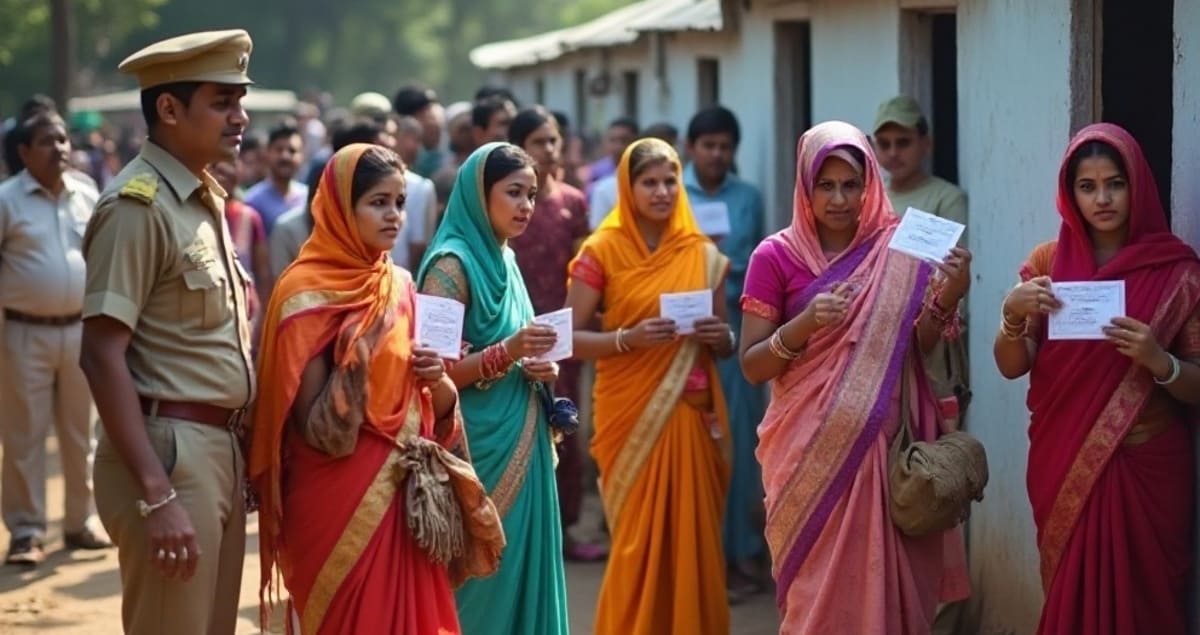
Smokescreen Report. AI-generated representational image of men and women standing outside a polling booth to vote in an Indian election. Photo: RMN News Service

The Smokescreen 2026: Voting Without Verification and the Collapse of Electoral Accountability in India

Smokescreen Report. AI-generated representational image of men and women standing outside a polling booth to vote in an Indian election. Photo: RMN News Service

The Smokescreen 2026: Voting Without Verification and the Collapse of Electoral Accountability in India

Democracy does not die only through coups or emergency declarations. It can also die quietly—through procedures that look lawful, elections that look competitive, and institutions that look independent, while collectively ensuring that outcomes are never meaningfully questioned.

By Rakesh Raman
New Delhi | January 26, 2026

India is routinely described as the world’s largest democracy. Yet, beneath the spectacle of record voter turnout, election festivals, and official slogans celebrating democratic participation, a deeper and more troubling reality has taken hold: Indian citizens are increasingly asked to vote without any credible means to verify where their vote ultimately goes.

The Smokescreen 2026 report documents how India’s electoral system has evolved into a managed illusion of democracy, sustained through Electronic Voting Machines (EVMs), institutional capture, and the systematic erosion of oversight mechanisms that once safeguarded electoral integrity.

Voting Rights Without the Right to Verification

The right to vote is not merely the act of pressing a button on polling day. It includes the right to transparency, auditability, and post-election verification. In India, this core democratic principle has been hollowed out.

Despite repeated public concerns, expert critiques, and legal challenges, Indian voters remain unable to independently verify whether their vote has been accurately recorded, counted, and reflected in final results. The limited VVPAT system, often cited as a safeguard, functions largely as a symbolic reassurance rather than a genuine audit mechanism. There is no statistically meaningful, voter-verifiable, or citizen-controlled audit of election outcomes.

A democracy that asks citizens to trust blindly—without verifiable proof—ceases to be a democracy in substance, regardless of how frequently elections are held.

🔊 द स्मोकस्क्रीन: भारतीय लोकतंत्र का प्रबंधित भ्रम: ऑडियो विश्लेषण ]

Electronic Voting Machines and Electoral Opacity

EVMs were introduced to prevent booth capturing and electoral fraud. Instead, over time, they have become the central source of electoral opacity.

The Smokescreen report does not rely on conjecture or partisan narratives. It compiles documented anomalies, procedural contradictions, judicial evasions, and the Election Commission of India’s consistent refusal to allow independent, transparent audits of EVMs. When institutions tasked with administering elections resist scrutiny rather than welcome it, democratic confidence erodes by design.

In any mature democracy, electoral technology is subjected to adversarial testing, independent certification, and public verification. In India, the opposite model prevails: secrecy, institutional defensiveness, and legal stonewalling.

Institutional Capture and the Failure of Domestic Remedies

A functioning democracy depends on institutional checks and balances. The Smokescreen report establishes that these safeguards in India have largely collapsed.

  • The Election Commission of India (ECI) increasingly operates as an executive-aligned administrator rather than an independent constitutional authority.

  • The judiciary, once seen as the last institutional refuge for citizens, has repeatedly avoided substantive adjudication on electoral transparency, often deferring to executive assurances without scrutiny.

  • Investigative agencies are selectively deployed, weakening the opposition while insulating the ruling establishment.

  • Parliamentary opposition, fragmented and risk-averse, has failed to mount sustained institutional or street-level resistance to systemic electoral concerns.

This convergence has created a closed loop of power where electoral outcomes reinforce institutional capture, and institutional capture ensures electoral outcomes.

Why International Supervision Has Become Necessary

International election observation is typically associated with fragile or transitional democracies. India was once a model that provided observers elsewhere. That moral authority has now been forfeited.

When domestic institutions fail simultaneously—when courts do not adjudicate, election bodies do not audit, and political opposition does not challenge—international democratic oversight becomes not interference, but necessity.

The call for international supervision is not a demand for external control. It is a request for neutral, professional, and transparent observation, aligned with global democratic norms that India itself has historically endorsed.

From Electoral Ritual to Democratic Reality

India today performs democracy exceptionally well. What it no longer guarantees is democratic accountability.

Celebrations like National Voters’ Day, grand election campaigns, and official proclamations about democratic duty ring hollow when citizens are denied the most basic democratic right: the ability to know whether their vote truly counts.

The Smokescreen 2026 report is a public-interest intervention aimed at restoring that right. It documents how electoral opacity, institutional capture, and manufactured consent have replaced transparency, accountability, and popular sovereignty.

Democracy does not die only through coups or emergency declarations. It can also die quietly—through procedures that look lawful, elections that look competitive, and institutions that look independent, while collectively ensuring that outcomes are never meaningfully questioned.

India now stands at that threshold.

By Rakesh Raman, who is a national award-winning journalist and social activist. He is the founder of a humanitarian organization RMN Foundation which is working in diverse areas to help the disadvantaged and distressed people in the society.
Top Image: AI-generated representational image of men and women standing outside a polling booth to vote in an Indian election. Photo: RMN News Service
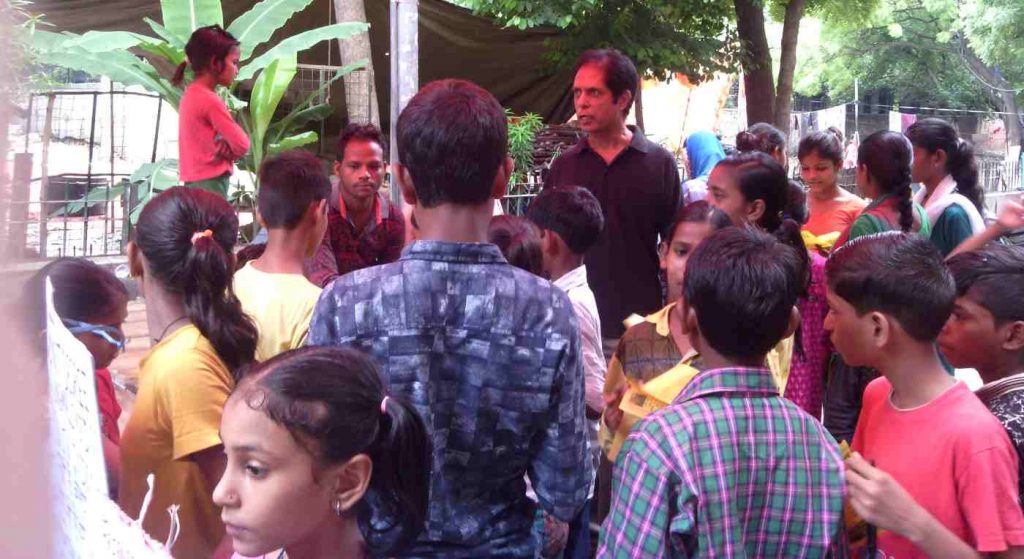
RMN Foundation founder Rakesh Raman running an education campaign with the help of student volunteers in New Delhi, India. Photo: RMN News Service

RMN Foundation Publishes Three Landmark Research Reports on Democracy, Judiciary, and Education

RMN Foundation founder Rakesh Raman running an education campaign with the help of student volunteers in New Delhi, India. Photo: RMN News Service

RMN Foundation Publishes Three Landmark Research Reports on Democracy, Judiciary, and Education

Each report is archived on Zenodo, developed under the European OpenAIRE program and operated by CERN, providing a permanent DOI-based citation. They are also available on Academia.edu for broader global access and research collaboration.

🗓️ RMN Foundation Reseach Desk
New Delhi, October 15, 2025

RMN Foundation has released three comprehensive research reports authored by Rakesh Raman, a national award-winning journalist and founder of the organization. These studies provide a data-driven and evidence-based assessment of India’s governance, justice, and education systems, highlighting the urgent need for structural reform.

1. India Judicial Research Report 2025: Decline of the Indian Judiciary

🔗 DOI (Zenodo): https://doi.org/10.5281/zenodo.17324442
📘 Academia.edu: Read Here

The India Judicial Research Report 2025 exposes deep-rooted corruption, administrative inefficiency, and institutional bias in the Indian judiciary. It includes case studies, data analysis, and 20 actionable recommendations for reform.

The report also examines global judicial indices, e-court technology failures, and the future of AI-driven justice systems, framing a roadmap for restoring accountability and transparency in Indian courts.

2. Unveiling the Smokescreen of Indian Democracy: Fabricated Factors Masking Electoral Manipulation

🔗 DOI (Zenodo): https://doi.org/10.5281/zenodo.17351579
🗳️ Academia.edu: Read Here

This political research report reveals that the electoral dominance of the Narendra Modi-led Bharatiya Janata Party (BJP) in India is not solely based on popular support.

Instead, it is driven by a multi-layered strategy involving manufactured narratives and widespread electoral manipulation, described as a national “smokescreen.”

The report deconstructs India’s electoral machinery, the influence of digital propaganda, and the structural weakening of democratic institutions.

3. Job with Education: School Education Report 2025 to Make Students Employable

🔗 DOI (Zenodo): https://doi.org/10.5281/zenodo.17351724
🎓 Academia.edu: Read Here

The School Education Report 2025 asserts that India’s educational crisis is directly linked to the country’s rising unemployment. Key findings reveal that school students are taught “obsolete subjects with archaic pedagogical methods”, textbooks are “written haphazardly”, and education quality remains “equally poor in both public and private schools.”

The report proposes a new “Job with Education” model, integrating employability skills with school learning.

Each report is archived on Zenodo, developed under the European OpenAIRE program and operated by CERN, providing a permanent DOI-based citation. They are also available on Academia.edu for broader global access and research collaboration.

“These reports are part of RMN Foundation’s ongoing effort to promote informed citizen participation, transparency, and institutional accountability through independent, evidence-based research,” said Rakesh Raman.

All reports can be accessed through the RMN Foundation and RMN News Service portals.

Rakesh Raman  |  LinkedIn  |  Facebook  Twitter (X)

A Call to Filmmakers Worldwide: “The Smokescreen” – A Global Political Thriller in the Vein of The Godfather. AI-generated image. By Rakesh Raman / RMN News Service

RMN Foundation Announces Political Thriller Film Project ‘Smokescreen’ to Champion Voting Rights

A Call to Filmmakers Worldwide: “The Smokescreen” – A Global Political Thriller in the Vein of The Godfather. AI-generated image. By Rakesh Raman / RMN News Service

RMN Foundation Announces Political Thriller Film Project ‘Smokescreen’ to Champion Voting Rights

New Cinematic Initiative to Expose Electoral Threats and Empower Voters

NEW DELHI – In a major new initiative to protect democracy and uphold electoral integrity, the RMN Foundation has announced a global political thriller film project titled The Smokescreen.” The film, which is being proposed to filmmakers worldwide, is based on the Foundation’s own extensive political research and is designed to serve as a powerful tool to educate the public and protect people’s fundamental voting rights.

The RMN Foundation, a humanitarian initiative of RMN News Service focused on social democracy and justice, believes that the critical issues facing the integrity of elections today demand a powerful and widely accessible platform. “The Smokescreen” is envisioned as a feature film that will engage audiences on a massive scale, much like the iconic film The Godfather did for its themes.

The film’s narrative will dramatically expose a multi-layered strategy allegedly used to secure power by masking core electoral concerns. It will delve into:

  • The Weaponization of Victimhood: How a leader’s public persona can be used as a shield against criticism.
  • The Politicization of National Security: How military events can be leveraged to divert public attention from economic and social issues.
  • The Politics of Doles and Media: How welfare schemes and media alignment can create a dependent voter base.

The core of the story, however, will focus on the most serious allegations: the concerns surrounding electronic voting machines (EVMs) and alleged electoral fraud. By bringing these complex and often-overlooked topics to life through a thrilling cinematic narrative, the RMN Foundation aims to make them accessible to a global audience.

Through this film project, the RMN Foundation seeks to achieve several key objectives:

  • Raise Global Awareness: Spark an international conversation about the fragility of democratic institutions and the need for transparent electoral processes.
  • Empower Citizens: Educate voters on the importance of understanding their rights and the potential threats to a free and fair election.
  • Support Advocacy: The film’s message will be used in educational campaigns to advocate for electoral reforms and greater accountability from governing bodies.

The related political research report titled “Unveiling the Smokescreen of Indian Democracy: Fabricated Factors Masking Electoral Manipulation” is written by national award-winning journalist Rakesh Raman.

The RMN Foundation’s work has consistently focused on raising a collective voice against corruption, injustice, and human rights violations. The “Smokescreen” film project is a natural extension of this mission, leveraging the power of storytelling to inspire action and demand a higher standard of democratic practice.

For more information on the RMN Foundation’s initiatives and to support its mission, please visit rmnfoundation.org.

The Unrest: Representational Image of a Protest Created with Adobe Firefly Generative AI. By RMN News Service

“Smokescreen” Report Alleges Widespread Electoral Manipulation and Democratic Backsliding in India

The Unrest: Representational Image of a Protest Created with Adobe Firefly Generative AI. By RMN News Service

“Smokescreen” Report Alleges Widespread Electoral Manipulation and Democratic Backsliding in India

The report concludes that the current political landscape paints a grim picture for India, where nearly 1.4 billion people are described as suffering from “unprecedented poverty, corruption, inflation, unemployment, lawlessness, and religious animosity”.

NEW DELHI – September 2025 – RMN Foundation has announced the release of a new political research report, “Unveiling the Smokescreen of Indian Democracy: Fabricated Factors Masking Electoral Manipulation“. Authored by national award-winning journalist Rakesh Raman, also the Editor of RMN News and Founder of RMN Foundation, the report asserts that India, the world’s most populated country, is grappling with an “unprecedented debate regarding the integrity of its electoral process”.

The report contends that the electoral dominance of the Narendra Modi-led Bharatiya Janata Party (BJP) is not solely based on genuine popular support but on a sophisticated, multi-layered strategy involving a “smokescreen” of manufactured narratives and alleged widespread electoral manipulation.

The “Smokescreen” report details a four-pronged strategy allegedly employed by the Modi regime to deflect criticism and maintain power:

Weaponization of Victimhood: This tactic reportedly reframes personal criticism of the Prime Minister as an attack on his identity, humble origins, or even the nation itself, aiming to rally supporters and deflect substantive policy critiques on issues like unemployment, poverty, and inflation.

Strategic Politicization of National Security Events: The report claims that national security issues and military actions, such as “Operation Sindoor,” the 2016 Uri terror attack, and the 2019 Balakot airstrike, are leveraged during electoral campaigns to generate nationalism and distract from critical economic and social issues like agrarian distress and unemployment.

Politics of “Doles,” Welfare, and Media Alignment: Government welfare schemes, branded as “Modi Ki Guarantee,” are presented as personal gifts from the Prime Minister to foster gratitude and dependency among voters. Programs like Pradhan Mantri Awas Yojana, PM-Kisan Samman Nidhi, and Pradhan Mantri Garib Kalyan Anna Yojana are highlighted, which critics contend are “doles” that do not address root causes of poverty. This narrative is amplified by a “lapdog media” that reportedly functions as a mouthpiece for the ruling party, marginalizing dissenting voices.

Ineffective Opposition: The perceived inability of the opposition, particularly the Indian National Congress, to effectively counter the BJP’s narratives and grassroots machinery, is presented as a public-facing reason for BJP’s victories, thereby allegedly masking underlying electoral fraud.

Beneath this political façade, the report outlines claims that the BJP’s electoral success is driven by alleged fraudulent practices, specifically concerning the integrity of Electronic Voting Machines (EVMs) and manipulated voter rolls. The report notes that the Congress government in Karnataka recently recommended reverting to paper ballots for local elections due to “eroded credibility” of EVMs. International figures like Elon Musk and President Donald Trump have also advocated for paper ballots, with Musk citing a “too high” risk of hacking for electronic voting machines. An RMN News Poll indicated that 89% of respondents prefer ballot papers for Indian elections.

The report points to the “Vote Chori” (vote theft) campaign, spearheaded by opposition leader Rahul Gandhi, which alleges “huge criminal fraud” in the 2024 polls, accusing the BJP and Election Commission of India (ECI) of collusion. Specific allegations include over 1 lakh fake voters in the Mahadevapura Assembly segment, which allegedly secured the Bangalore Central Lok Sabha seat for the BJP by a narrow margin. The report also highlights the “Selective Wins” theory, positing that the BJP selectively manipulates EVMs to win crucial state and national elections, while allowing opposition wins in less critical states to maintain the illusion of a fair democracy.

The report concludes that the current political landscape paints a grim picture for India, where nearly 1.4 billion people are described as suffering from “unprecedented poverty, corruption, inflation, unemployment, lawlessness, and religious animosity”. In such a climate, “honest and educated candidates” may struggle to be elected because the electoral process is deemed “neither fair nor transparent”. The report asserts that “without EVM manipulation, electoral roll frauds, bribes to voters, threats to voters, etc.,” Modi and the BJP “cannot win even a single election”.

Rakesh Raman is a national award-winning journalist and the founder of the RMN Foundation, a humanitarian organization. His extensive work includes running global news services, various anti-corruption and human rights campaigns, and providing expert research inputs as a Country Expert for India to the Varieties of Democracy (V-Dem) Project under the University of Gothenburg, Sweden. He also leads a nationwide campaign for social democracy and justice and focuses on concerns about electronic voting machines in Indian elections.

About RMN Foundation: The RMN Foundation is a humanitarian organization dedicated to advocating for social democracy and justice, running various campaigns including environment protection, human rights protection, education awareness, and anti-corruption initiatives. It also publishes research reports on different subjects and is involved in addressing concerns about electoral integrity.

Rakesh Raman  |  LinkedIn  |  Facebook  | Twitter (X)