Tag: RCS

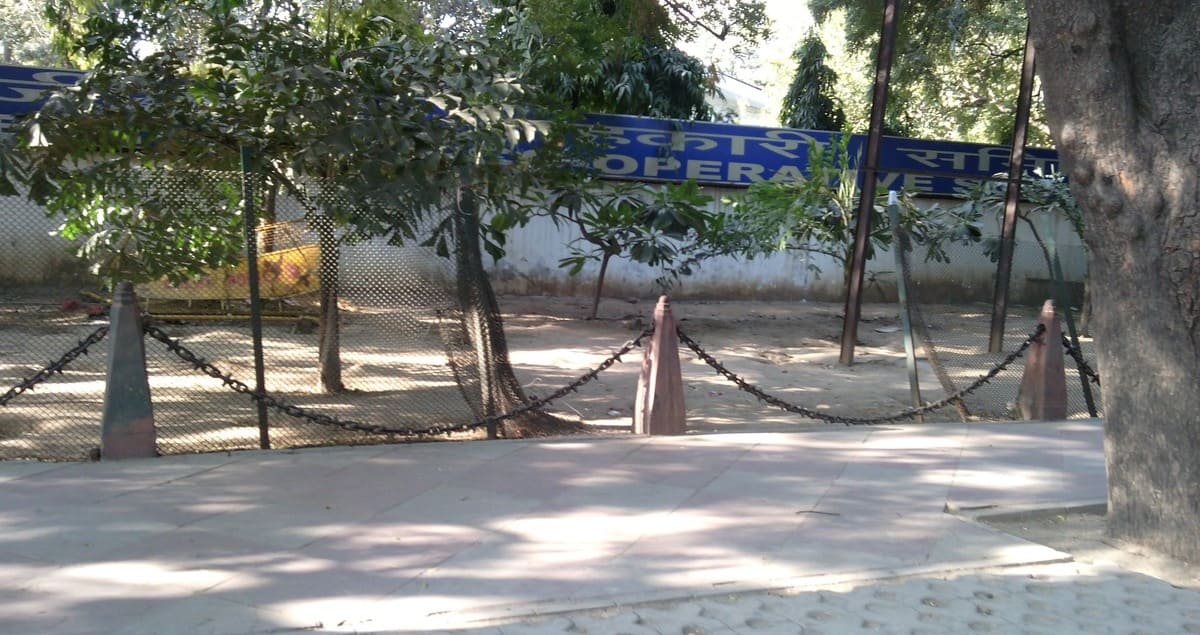
Office of the Registrar Cooperative Societies (RCS) of Delhi Government, which is among the most corrupt departments of India. Photo: Rakesh Raman / RMN News Service

Monitoring Power: A Journalism Case Review of Institutional Accountability

Office of the Registrar Cooperative Societies (RCS) of Delhi Government, which is among the most corrupt departments of India. Photo: Rakesh Raman / RMN News Service

Monitoring Power: A Journalism Case Review of Institutional Accountability

By Rakesh Raman
New Delhi | March 4, 2026

1. The Foundation of Independent Oversight

In an era where digital news is often ephemeral and prone to manipulation, independent outlets like RMN News Service and its flagship publication The Unrest are redefining the architecture of media accountability. This methodology, which I term “Scholarly Journalism,” serves as a structural defense against the transience of digital discourse.

By utilizing the Zenodo open research platform—operated by CERN under the OpenAIRE program—these reports are not merely articles but permanent, scholarly artifacts. Assigned unique Digital Object Identifiers (DOIs), these investigations are transformed into citable, immutable records that resist institutional erasure and provide a durable evidentiary base for public scrutiny.

Key Takeaway: The Architectural Permanence of Truth Accountability in the modern age requires more than just reporting; it requires a commitment to permanent, scholarly archiving. By treating investigative findings as research-grade evidence stored on high-integrity platforms like Zenodo, journalists ensure their work remains accessible to future scholars and legal bodies, effectively preventing powerful actors from “editing” the historical record.

While the methodology of preservation ensures the transparency of the record, the analytical weight of this journalism is found in the specific subjects it monitors to protect the public interest from systemic subversion.

2. Political Accountability and Narrative Control

A rigorous investigative framework must deconstruct the “official narrative” to reveal the underlying mechanisms of power. In the Indian context, this involves scrutinizing state-sponsored communication and the efficacy of the opposition’s resistance to institutional capture.

Official Narrative Investigative Counter-Narrative
Mann Ki Baat: A curated radio program presented as a direct, benevolent engagement between the Prime Minister and the citizenry. Narrative Control: Analyzed as a calculated psychological tool designed to monopolize the public sphere and prevent damaging scandals from reaching the level of interactive debate.
Strategic Global Leadership: National governance focused on trade and international standing. Secretive Trade Deal Allegations: Scrutiny of claims by figures like Rahul Gandhi, suggesting that secretive U.S. trade deals may fundamentally compromise national sovereignty.
Vibrant Democratic Opposition: A political landscape defined by active multi-party dissent and robust debate. Strategic Hibernation: A critique of opposition leadership (e.g., Rahul Gandhi) for failing to move beyond rhetoric into street-level protest, effectively stalling democratic resistance.

While national politics establishes the macro-environment, the integrity of a democracy is truly tested through the financial stability of its regions and the transparency of its judicial and legal outcomes.

3. Institutional Integrity: Law, Debt, and Justice

When the pillars of governance—the treasury, the courts, and the legal system—falter, the result is a state of “institutional capture.” The following cases illustrate the fragility of these systems when subjected to political or economic pressure.

Case Study 1: Judicial Accountability and Information Suppression

  • The Event: The Supreme Court mandated a ban on a new Class 8 textbook.
  • Institutional Risk: The book contained a dedicated section discussing systemic corruption within the Indian judiciary.
  • Public Impact: This represents a conflict where judicial authority is used to censor educational content, potentially shielding the legal system from the very public scrutiny necessary for its reform.

Case Study 2: Regional Economic Crises and the Debt Trap

  • The Event: Punjab’s public debt has surpassed the ₹4 lakh crore threshold ahead of the 2027 elections.
  • Institutional Risk: A reliance on unsustainable “free” schemes to secure political viability.
  • Public Impact: This creates a terminal strategic juncture where short-term populist gains threaten the long-term economic survival and sovereignty of the state.

Case Study 3: Legal Outcomes and the “Smokescreen” Effect

  • The Event: The total legal acquittal of Arvind Kejriwal and Manish Sisodia in the Delhi Excise Policy case.
  • Institutional Risk: The collapse of a protracted and high-profile corruption narrative.
  • Public Impact: Landmark acquittals can dismantle long-held public perceptions of guilt, suggesting that previous investigative efforts may have been mere “smokescreens”—a concept explored in the “Smokescreen” research foundation—designed for political theater rather than justice.

These failures of human-led institutions to maintain objective justice are increasingly leading society to delegate oversight to algorithmic systems, bringing us to a new and dangerous technological frontier.

4. The AI Frontier: Corporate Ethics and Technological Oversight

As traditional systems of justice and media erode, we have reached a “death of the newsroom dinosaur” moment. Investigative journalism must now pivot to monitor the “AI Identity Crisis,” where technological complexity is often used to mask corporate malfeasance and narrative manipulation.

  1. Identity Crisis at the Summit: At the India AI Impact Summit, OpenAI CEO Sam Altman engaged in an “awkward unity gesture” with Prime Minister Modi and tech rivals, illustrating the confusion and lack of ethical clarity currently defining the industry.
  2. The Three-Front War for Model Integrity: AI startup Anthropic exemplifies the current chaos, facing a simultaneous legal battle with the Pentagon, large-scale data theft and “model distillation” by Chinese tech firms, and a federal ban imposed by the Trump administration.
  3. Weaponized Cinema and Institutional Capture: The Astraea political thriller film project, built on the “Smokescreen” research foundation, demonstrates how investigative research is being converted into cinematic narratives to combat democratic erosion. Meanwhile, projects like the Robojit Universe attempt to find “bilateral ensemble stability” through AI-assisted production.
  4. Economic Uncertainty for Traditional Media: Newsrooms are using AI to aggressively cut costs to survive, leading to mass layoffs and a weakening of the traditional print model, which further diminishes the capacity for deep investigative work.

These global technological concerns eventually manifest at the “hyper-local” level, where the breakdown of the rule of law impacts the daily safety and financial security of citizens in their own homes.

5. Hyper-Local Accountability: The “Clean House” Model

The mission of media accountability finds its most practical application in the residential sector, specifically within the geographic locus of Dwarka, New Delhi. The “Clean House” model treats housing corruption as a microcosm of systemic legal failure.

Steps to Local Oversight:

  • Administrative Surveillance: Monitoring the Registrar Cooperative Societies (RCS) to ensure it moves beyond bureaucratic stagnation. A key milestone in this effort was the RCS issuing a fresh notice regarding allegations of financial extortion and illegal construction at the Him Hit CGHS.
  • Geographic Focus and Reporting: Documenting the breakdown of the rule of law in specific societies like Chinar Co-operative Group Housing Society to expose local mismanagement.
  • The Community Court Intervention: Utilizing the “Clean House” service as a community court where residents can report crimes—such as financial mismanagement and extortion by management committees—that are typically ignored by mainstream media.
  • Documentary Evidence: Transforming local grievances into formal reports that can be used for legal and administrative recourse.

These diverse reporting themes—from Dwarka’s housing societies to the global AI summits—coalesce into a singular mission of institutional monitoring.

6. Synthesis: The “So What?” for the Aspiring Learner

For the modern citizen, this investigative framework serves as a “global pulse monitor.” It tracks the rhythmic fluctuations of political, economic, and technological upheavals to ensure that democracy does not die in the silence of institutional capture. Effective journalism is not just a summary of events; it is a structural audit of power.

Learner’s Checklist for Effective Investigative Monitoring

  • [ ] Research-Driven Perspectives: Does the reporting prioritize data and citable records over mere opinion or government press releases?
  • [ ] Archival Transparency: Is the information stored on permanent, scholarly platforms (e.g., Zenodo/DOI) to protect against digital erasure?
  • [ ] Cross-Sector Scrutiny: Does the media monitor the interplay between government (political narratives) and the corporate sector (AI ethics and data theft)?
  • [ ] Multi-Level Reporting: Does the outlet connect hyper-local issues (like Dwarka housing corruption) to macro-level trends (like democratic erosion)?
  • [ ] Deconstruction of Official Narratives: Does the reporting actively question “official” programs like Mann Ki Baat or high-level summits to find the counter-narrative?

By Rakesh Raman, who is a national award-winning journalist and social activist. He is the founder of a humanitarian organization RMN Foundation which is working in diverse areas to help the disadvantaged and distressed people in the society.

Top Image: Office of the Registrar Cooperative Societies (RCS) of Delhi Government, which is among the most corrupt departments of India. Photo: Rakesh Raman / RMN News Service
Understanding Corruption in Delhi's Housing Societies | RMN Foundation Report

The Secret Rulebook: Understanding Corruption in Delhi’s Housing Societies

Understanding Corruption in Delhi's Housing Societies | RMN Foundation Report

The Secret Rulebook: Understanding Corruption in Delhi’s Housing Societies

The corruption is guaranteed to continue because the official channels for accountability and justice have effectively collapsed. Residents who try to fight back find themselves trapped in a system that is either indifferent, corrupt, or actively working against them.

By Rakesh Raman
New Delhi | January 12, 2026

Introduction: The Broken Promise of Community Living

A cooperative housing society is supposed to be a community built on shared responsibility and mutual benefit. It’s an idea that promises residents a secure, harmonious, and well-managed place to live. However, for millions of people in Delhi, this promise has been broken. Their communities have become centers of crime, widespread corruption, and systemic harassment.

This document explains why this is happening by focusing on one central problem: a deliberate and calculated lack of transparency. We will explore how a simple rule designed to ensure honesty has been systematically ignored, creating a hidden world where corruption is allowed to thrive.

1. The Simple Rule That Was Meant to Keep Things Honest

Every housing society is run by an elected group of residents called a Management Committee (MC). To prevent these committees from becoming corrupt, the Delhi Government’s Registrar Cooperative Societies (RCS) office created a simple but powerful solution: every single society must have a transparent, regularly updated website.

This rule has been official policy since at least 2015 and has been reinforced multiple times. Complying with this rule has almost no cost, as free software and platforms are widely available. The goal was to empower residents with information and hold their elected MCs accountable.

What Every Society Website Must Show

The RCS directives are supposed to ensure that a society’s information must be publicly available and kept up-to-date. The information may include:

  • Details of all members of the society.
  • Complete records of all financial transactions, including purchase documents and vouchers.
  • Details of all contracts and the criteria used for the appointment of vendors.
  • Regular updates on the status of all legal cases involving the society.
  • An online form for members to register complaints and an official email for communication.
  • A complete record of all internal and external communications.
  • Instant and regular updates of all communications between members and the MC, ensuring a real-time record of interactions.

This clear rule was designed to be a straightforward tool for honesty. However, the reality on the ground reveals a massive gap between this policy and what is actually happening.

2. A Rule Ignored: The Widespread Defiance

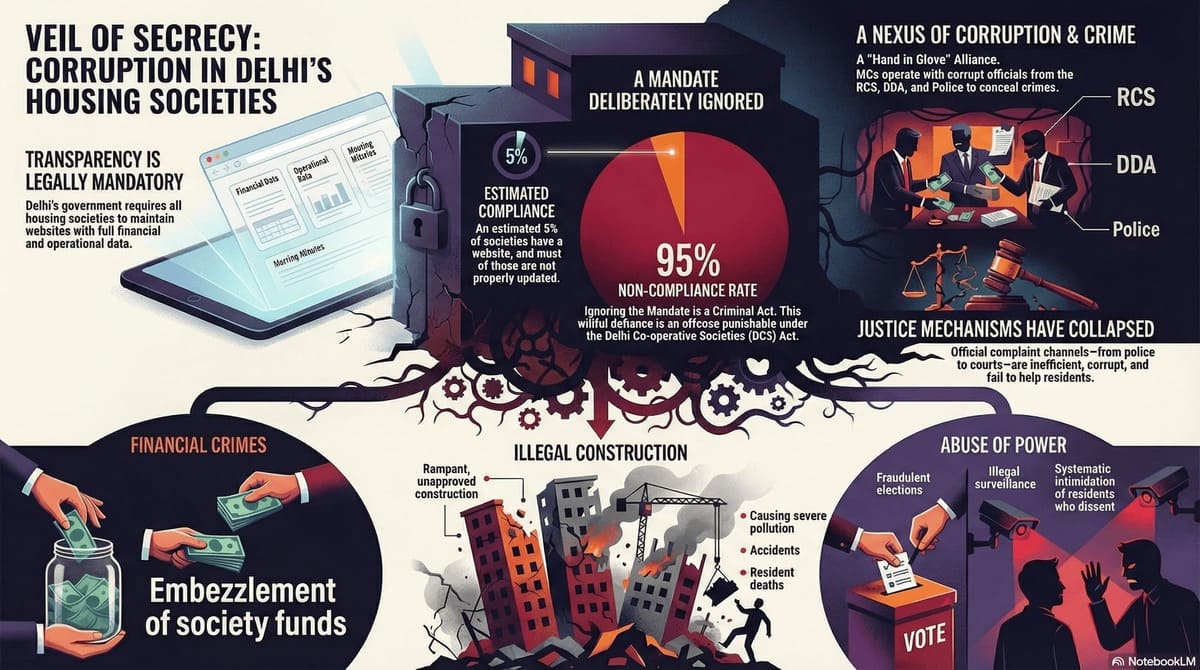
The scale of the problem is staggering. An estimated 95% of housing societies in Delhi do not have a website. Of the mere 5% that do, most are useless because they are never updated with the required information.

According to the investigative report, this isn’t a simple oversight or a technical challenge. It is described as a “willful defiance” and a “blatant ignoring” of a legally binding government order. The law is clear on this point:

Failing to establish and maintain an updated website is legally considered an “offence” and a “criminal act”. The MC members responsible can be prosecuted under the Delhi Co-operative Societies (DCS) Act and relevant sections of the Indian Penal Code (or its successor, the Bharatiya Nyaya Sanhita, 2023).

This exposes a critical question: How do so many Management Committees get away with openly breaking the law?

3. The Secret Partnership: How Corruption is Protected

The primary reason this defiance is so widespread is a corrupt partnership where Management Committees operate “hand in glove” with government officials. This secret alliance creates a protective shield, allowing MCs to ignore the law without any fear of consequences.

This network of complicity extends across multiple government bodies, each playing a role in protecting corrupt MCs.

The Network of Complicity

Government Body How They Help Corrupt MCs
Registrar Cooperative Societies (RCS) Allegedly accepts bribes to ignore non-compliance with the website rule and closes resident complaint cases without taking any real action.
Delhi Development Authority (DDA) Supports corrupt MCs in illegal activities, particularly unauthorized construction projects.
Delhi Police Described as “perhaps the most corrupt police force in the country”; consistently fails to take action against MCs and has been accused of deliberately omitting their names from official reports (FIRs) for serious crimes.
Municipal Corporation of Delhi (MCD) Implicated in the network of connivance, further enabling illegal activities.
Other Delhi Govt. Departments This includes the Delhi Jal Board (DJB), Delhi Fire Service (DFS), and Delhi Pollution Control Committee (DPCC), expanding the protective shield.
Ruling Politicians Allegedly receive a share of the bribe money collected by departments, ensuring they turn a blind eye to the widespread corruption.

This network ensures that the very system designed to regulate housing societies is instead used to protect criminal activity. This official protection allows a range of harmful and illegal acts to flourish within these communities.

4. The Real-World Harm: What Happens When No One is Watching

This deliberate secrecy is not a victimless crime. It directly enables criminal activities that harm residents, violate their rights, and damage their communities both financially and physically.

Financial Crime

Without transparent records, MCs can easily misuse society funds. Key examples include:

  • Swindling society funds through large, expensive projects where costs can be inflated and money embezzled.
  • Illicitly selling car parking spaces to residents in exchange for substantial bribes.
  • Allowing society staff, such as plumbers and electricians, to “fleece the residents by charging heavy amounts even for small tasks,” likely while taking illicit commissions.

Dangerous Construction

The lack of oversight allows illegal Floor Area Ratio (FAR) construction to run as a massive “extortion racket.”

  • This activity subjects thousands of residents, including children and the elderly, to severe and prolonged noise and dust pollution.
  • This unauthorized construction often leads to serious and even fatal accidents, all while generating illegal profits for the MCs and their official partners.

Abuse of Power

Unchecked by any real oversight, MCs can abuse their authority and violate the human rights of residents.

  • They hold fraudulent elections to stay in power, with the same members often rotating posts for decades.
  • They intimidate residents who dare to complain or ask questions.
  • They allow nuisances that degrade the quality of life, such as tolerating “ferocious dogs” that disturb residents or allowing constant, disruptive construction that turns buildings into “war-torn regions.”

When residents try to seek help from the authorities to stop these abuses, they discover that the systems designed to protect them are completely broken.

5. A System of Failure: Why Getting Help is Nearly Impossible

The corruption is guaranteed to continue because the official channels for accountability and justice have effectively collapsed. Residents who try to fight back find themselves trapped in a system that is either indifferent, corrupt, or actively working against them.

An analysis of the four main channels for recourse reveals a consistent pattern of failure:

1. RCS Inquiries: These are described as “perfunctory” or superficial. The RCS may send a notice, but cases are routinely closed without providing any relief to the resident, allegedly because officials are bribed by the MCs.

2. The Courts: The judicial system is “overcrowded” and “inefficient.” This means that even if a resident goes to court, they face extremely long delays and often receive unjust decisions, making it an unworkable option for most.

3. Online Grievance Portals: Government portals are often managed by the same corrupt officials who are part of the problem. As a result, complaints are closed without any meaningful action being taken.

4. The Delhi Police: The police force consistently fails to act on complaints. In cases of serious crimes, such as deaths from illegal construction, they have been accused of deliberately removing the names of the responsible MC members from official reports.

This total system failure leaves residents with virtually no official way to fight back against the corruption and abuse they face.

6. A Call for Real Change

The problems in Delhi’s housing societies are not just isolated incidents of mismanagement. They are the direct result of a deliberate, systemic, and corrupt ecosystem built on a foundation of secrecy. The failure to enforce one simple rule—the mandatory website—has enabled a criminal alliance between Management Committees and government officials to flourish, turning communities into personal fiefdoms.

The source report goes so far as to describe Delhi as the “corruption capital of India,” highlighting that this issue is part of a much larger crisis of governance. To restore the rights of millions of residents and reclaim the promise of cooperative living, fundamental reforms are needed. The two most critical and immediate actions are:

  • Prosecuting non-compliant MC members to enforce the law and create genuine accountability.
  • A complete and transparent revamp of the corrupt RCS office to break the cycle of complicity.

The source report argues that given the scale of the crisis, more drastic measures are necessary to break the criminal enterprise:

  • A call for a “separate jail” to be built specifically for corrupt MC members and the bureaucrats who enable them.
  • The need for intervention from international human rights and law-enforcement agencies, given the “categorical failure of India’s judicial forums to provide justice.”

Top Image: Understanding Corruption in Delhi’s Housing Societies | RMN Foundation Report

By Rakesh Raman, who is a national award-winning journalist and social activist. He is the founder of a humanitarian organization RMN Foundation which is working in diverse areas to help the disadvantaged and distressed people in the society.

He has been running for the past 8 years a community-driven anti-corruption social service “Clean House” to help the residents of Delhi who are victims of crime and corruption committed by the management committees (MCs) of Delhi’s Cooperative Group Housing Societies (CGHS). 

Anti-Corruption Activist Demands Action Against Delhi IAS Officers in Widespread Corruption Scandal. Photo: RMN News Service

Anti-Corruption Crusader Demands Swift Action in Delhi Bureaucratic Scandal

Anti-Corruption Activist Demands Action Against Delhi IAS Officers in Widespread Corruption Scandal. Photo: RMN News Service

Anti-Corruption Crusader Demands Swift Action in Delhi Bureaucratic Scandal

The scandal, dubbed the “Widehouse Corruption Scandal,” involves a complex racket allegedly orchestrated by senior officials and their accomplices.

By Rakesh Raman

New Delhi, July 25, 2025 – An anti-corruption activist Rakesh Raman has escalated his call for accountability, urging authorities to prosecute several senior Indian Administrative Service (IAS) officers implicated in a sprawling corruption scandal in Delhi. 

Raman, who publishes The Integrity Bulletin and annual India Corruption Research Reports, alleges that these officials are part of a citywide crime network involving corrupt bureaucrats, politicians, police, judicial members, and builders’ mafia, collectively causing significant harm to Delhi residents.

In a formal complaint lodged with the Department of Personnel and Training (DoPT) and the Cabinet Secretariat on July 3, 2025, Raman highlighted that the DoPT has repeatedly directed the Cabinet Secretariat to investigate the officers’ alleged misconduct. 

As a department of the Government of India, among other responsibilities, the DoPT determines government policy for the maintenance of the integrity of the public services and eradication of corruption.

In an update, the DoPT responded to Raman’s complaint with an Office Memorandum dated July 21, 2025, again directing the Cabinet Secretariat to investigate the case of IAS officers at the level of Secretary to the Government of India. 

[ Also Read: How Criminals Abuse the Legal System in India to Attack Press Freedom ]

Despite these directives, no concrete action has been reported, prompting Raman to accuse authorities of deliberate inaction to shield the accused. Responses to Right to Information (RTI) queries indicate that the investigation remains “under process” with no visible progress.

The scandal, dubbed the “Widehouse Corruption Scandal,” involves a complex racket allegedly orchestrated by senior officials and their accomplices. Raman’s detailed report outlines the network’s modus operandi, claiming it has siphoned off thousands of crores of rupees. While some IAS officers are under scrutiny, their accomplices, including junior officials at the Delhi Development Authority (DDA), the office of Registrar Cooperative Societies (RCS), local criminals, and builders’ mafia, remain at large.

Raman has called for the immediate suspension and prosecution of the implicated officers, warning that failure to act within a stipulated timeframe could suggest complicity by higher authorities. The ongoing delay in addressing these allegations has fueled public discontent, with thousands of Delhi residents reportedly suffering due to unchecked corruption.

As the investigation stalls, Raman continues to push for transparency and justice, emphasizing the need for systemic reforms to curb bureaucratic corruption in India’s capital.

🚨 You can click here to read the full report including the names of the accused IAS officers.

By Rakesh Raman, who is a national award-winning journalist and social activist. He is the founder of a humanitarian organization RMN Foundation which is working in diverse areas to help the disadvantaged and distressed people in the society.

Office of the Registrar Cooperative Societies (RCS) of Delhi Government, which is among the most corrupt departments of India. Photo: Rakesh Raman / RMN News Service

Process for Residents to File Complaints Against Housing Societies in Delhi
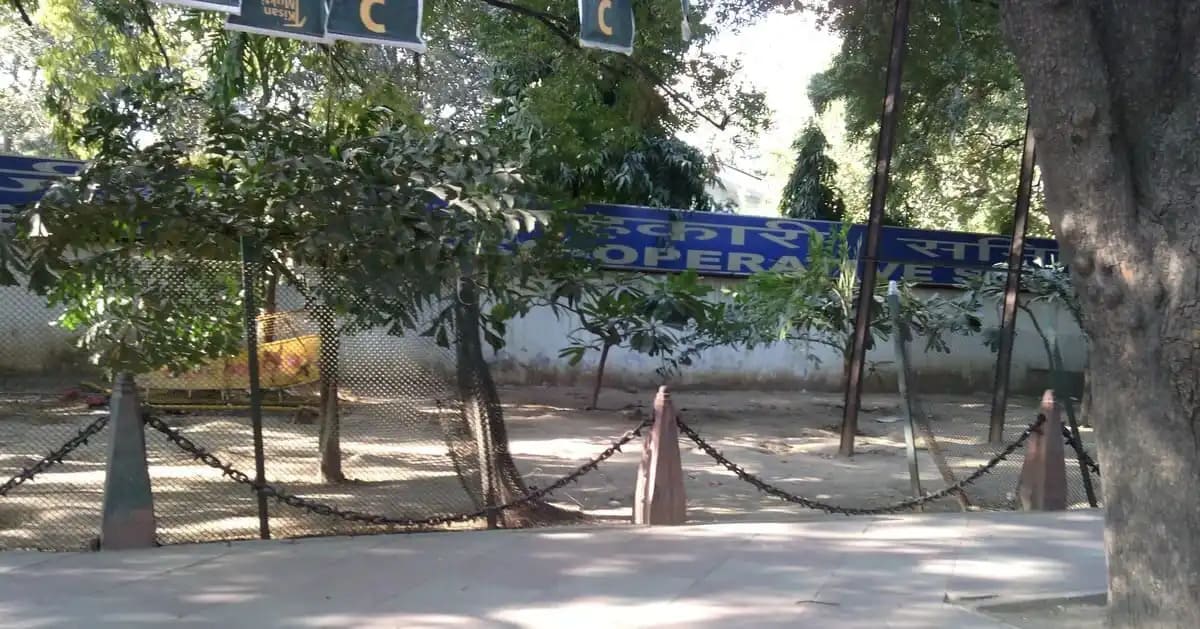
Office of the Registrar Cooperative Societies (RCS) of Delhi Government, which is among the most corrupt departments of India. Photo: Rakesh Raman / RMN News Service

Process for Residents to File Complaints Against Housing Societies in Delhi

“Clean House” runs as a community court to report about crime and corruption happening in Delhi’s cooperative group housing societies.

By Rakesh Raman

Introduction

The cooperative group housing societies (CGHS) of Delhi have become dangerous centres of crime and corruption. The crimes in these housing societies are being committed by the management committee (MC) members or administrators in connivance with the corrupt officials of Registrar Cooperative Societies (RCS) of Delhi Government, Delhi Development Authority (DDA), Delhi Police, Delhi Pollution Control Committee (DPCC), and a few other departments.
When the residents do not get proper response from their MCs or other government departments, they file their complaints at the offices of the Lt. Governor (LG) of Delhi or the Chief Minister (CM) and other Ministers of Delhi.

While Delhi CM and other ministers of Delhi Government are themselves embroiled in massive corruption cases and Delhi LG is an incompetent bureaucrat, they do not resolve public grievances. So, the aggrieved residents do not have any administrative forum where they could complain and get relief.

The crimes being committed by the housing society MCs in collusion with government officials include corruption, fraud, cheating, bribery, intimidation, extortion, unauthorised construction, environmental damage, and so on.

After facing extreme harassment by the MC members, some residents file their cases in courts. But since courts are always overcrowded and judicial systems are inefficient, the court decisions are either inordinately delayed or lack justice. The less said about the Indian courts, the better.

In a nutshell, utter lawlessness has been persisting in Delhi.

Clean House Service

In order to help the residents who are tortured by the MC members in different housing societies, as a journalist and social activist I have been running the “Clean House” service for the past 7 years.  

“Clean House” runs as a community court to report about crime and corruption happening in Delhi’s cooperative group housing societies. While hundreds or thousands of suffering residents have already availed the services offered by “Clean House,” more residents are encouraged to file their complaints through this online service.

Extension of “Clean House” Service: Now, in 2025, the scope of “Clean House” service has been extended to include DDA flats, J.J. Colonies, and other types of houses where residents are suffering because of government corruption or carelessness.

The complaint-handling process for “Clean House” takes place with the following steps:

Step 1: The complainant fills out a simple online form and informs me through WhatsApp or email that they have submitted the form.

Step 2: After receiving the form, I will contact you over the phone to briefly discuss the case and seek relevant documents about your complaint.

Step 3: I will hold an online meeting with you on Zoom, Google Meet, etc. for about 20 minutes to understand the case. The meeting will be recorded as a video. This meeting video will be published under the “Clean House” service page where your case is published as well as on YouTube. The case information as well as the meeting video will be publicly available.

Step 4: The complainant will also send me at least 2 photographs in horizontal / landscape format of their housing society building from the front side where the name of their society is written and where a particular incident such as illegal construction, tree felling, encroachment, etc. has happened. 

Step 5: Depending on the case and with your consent given in the online form, I will issue a formal notice to the MC of the housing society against which you have filed the complaint. I will wait for the MC’s response for a couple of days and then – if required – I will approach the authorities such as the RCS, DDA, Delhi Police, or others to get the matter resolved.

Step 6: Depending on the response from the MC or the authorities, I will keep updating the webpage on which a particular housing society’s case is published under the “Clean House” service. I also urge the complainants to share this webpage link with their friends, colleagues, and neighbours through WhatsApp, email, or social media platforms.

References: You can click the following links to study some of the cases that I have handled for different housing societies.

[ Case Link 1 ]

[ Case Link 2 ]

[ Video Link ]

[ Case Link 3 ]

[ Online Form to Register Your Complaint ]

[ Clean House Service Link ]

Principle: It is only an editorial and advisory service, which does not commit any favourable outcome to the complainants. This service is based on the principle that if information about some criminal activity is in the public domain on a dedicated media platform, there is a probability that it will get noticed and addressed by the law-enforcement agencies.

Latest Video Meetings
Illegal Construction FAR Crime and Threats Entry Fee
YOUTUBE VIDEOS ON HOUSING SOCIETY CASES
FAR Construction Money from New Members Most Corrupt MCs
Illegal Activity  Electricity Subsidy Fraud FAR Construction Damage
Entry Fee in Societies Illegal Construction Demand of Undue Money
Complaint Process Lethal FAR Project RAFAR Group
MC Corruption Online Form Letters to Stop FAR
Membership Money PGMS Service Crimes by MCs

You are requested to subscribe to the RMN YouTube Channel.

Also, people will not be willing to buy flats or live as tenants in those housing societies whose crime and corruption cases are reported under the “Clean House” service. The value of flats in these housing societies is expected to fall and they will be treated with disdain in the city and social circles.

In order to extend the reach of this service, I use all the information of different housing society cases on my media properties to publicly inform others including the authorities about the cases that I compile. 

Since I work alone to provide this free service along with my other editorial and social responsibilities, my response to your complaint can get delayed.

Donation: While I am providing this “Clean House” service free of charge to the residents, you are requested to support it with your donations. You can click here to donate online or click here to pay to our bank account. 

Note: The “Clean House” service will not take up the cases of those residents / complainants who have hired the services of lawyers / advocates.  

You can also click here to read about the “Most Corrupt Management Committees MCs in Delhi Housing Societies.”

Email Checking: Since the free email services such as Hotmail, Gmail, and Yahoo Mail are behaving erratically, you are advised to always check your Spam box to retrieve the genuine emails. You can click here to read a related article that I wrote recently.

[ VIDEO: You can click here to watch a related video in Hindi. It is also given below. ]

Thank You

Contact

Rakesh Raman
Editor, RMN News Service [ Website ]
Founder, RMN Foundation [ Website ]
463, DPS Apts., Plot No. 16, Sector 4
Dwarka, Phase I, New Delhi 110 078, India
WhatsApp / Mobile: 9810319059 | Contact by Email

Senior citizens in a group housing society of Dwarka in New Delhi urge the government to save them from dust and noise pollution of extended FAR construction activity. Photo and Campaign by Rakesh Raman / RMN News Service (file photo)

RTI Application to Seek Floor Area Ratio (FAR) Construction Information from DDA

Senior citizens in a group housing society of Dwarka in New Delhi urge the government to save them from dust and noise pollution of extended FAR construction activity. Photo and Campaign by Rakesh Raman / RMN News Service (file photo)

RTI Application to Seek Floor Area Ratio (FAR) Construction Information from DDA

As a journalist and environmental activist, I have been running citywide campaigns to stop FAR construction.

By Rakesh Raman

Floor Area Ratio (FAR) Construction in Delhi’s Cooperative Group Housing Societies (CGHS) is a dangerous work which spreads harmful pollution and causes accidents in housing complexes where people (men, women, children, and senior citizens) are living. 

As a journalist and environmental activist, I have been running citywide campaigns to stop FAR construction. In March / April 2024, I had sent RTI applications to various departments including Delhi Development Authority (DDA), Delhi Police, Registrar Cooperative Societies (RCS) of Delhi Government, and Delhi Fire Service (DFS) to seek FAR information. 

But none of these departments gave me the information that I demanded in my RTI applications because FAR work is a massive construction-cum-corruption scheme being run in Delhi by builders’ mafia in connivance with criminal management committee (MC) members of housing societies and corrupt government officials. 

Again, I sent the following RTI application to DDA.

To                                                                                                                October 3, 2024

The Public Information Officer (PIO)
Ministry of Housing and Urban Affairs (MoHUA), Government of India / DDA

Subject: RTI Application to Seek Information under the Right to Information Act 2005
Name of the Applicant: Rakesh Raman

Dear PIO at MoHUA / Delhi Development Authority (DDA),

Please provide me with the following information under the RTI Act:

1. List of Cooperative Group Housing Societies of Delhi where Floor Area Ratio* (FAR) construction has been approved / sanctioned during 2018 to 2024.

2. List of Cooperative Group Housing Societies of Delhi where Floor Area Ratio (FAR) construction has been stopped during 2018 to 2024.

3. List of Cooperative Group Housing Societies of Delhi where Floor Area Ratio (FAR) construction projects are being carried out by Design N Design Architects.

4. List of Cooperative Group Housing Societies of Delhi where Floor Area Ratio (FAR) construction projects are being carried out by Om Star Constructions Pvt Ltd.

5. List of Cooperative Group Housing Societies of Delhi from where residents have complained against Floor Area Ratio (FAR) construction during 2018 to 2024.

6. List of Cooperative Group Housing Societies of Delhi from where residents have filed court cases against Floor Area Ratio (FAR) construction.

7. Give me the official / DDA website address on which all FAR information is uploaded.

*Floor Area Ratio (FAR) or extended construction to add more rooms, balconies, etc. in occupied housing societies of Delhi. You can click here to watch a video and click here to read a report on FAR construction.

If this information is not available in your office, please forward my application to the concerned public information authority to seek information and provide it to me. 

Note: Delhi residents who oppose FAR construction can send me their complaints on the “Clean House” service that I have been running for the past 7 years to report about crime and corruption in housing societies. You can click here to know the process for filing your complaint.

By Rakesh Raman, who is a national award-winning journalist and social activist. He is the founder of the humanitarian organization RMN Foundation which is working in diverse areas to help the disadvantaged and distressed people in the society.

Rakesh Raman
Editor, RMN News Service [ Website ]
Founder, RMN Foundation [ Website ]
463, DPS Apts., Plot No. 16, Sector 4
Dwarka, Phase I, New Delhi 110 078, India

WhatsApp / Mobile: 9810319059 | Contact by Email

Office of the Registrar Cooperative Societies (RCS) of Delhi Government, which is among the most corrupt departments of India. Photo: Rakesh Raman / RMN News Service

How to Stop Crimes and Corruption in Delhi

Office of the Registrar Cooperative Societies (RCS) of Delhi Government, which is among the most corrupt departments of India. Photo: Rakesh Raman / RMN News Service

How to Stop Crimes and Corruption in Delhi

Today, crimes and corruption in Delhi’s cooperative group housing societies (CGHS) are increasingly rapidly, while the existing laws for these societies are ineffective. The Registrar Cooperative Societies (RCS) office of Delhi Government, which is supposed to regulate the CGHS affairs, has completely failed in its responsibility to ensure smooth and transparent functioning in the housing societies.

Therefore, there is an immediate need to formulate new laws and implement an effective administrative model to safeguard the rights and interests of millions of people who live in these housing societies.

The newly elected Members of the Legislative Assembly (MLAs) after the Delhi Assembly election in February 2020 should take up the Delhi Housing Societies Bill, 2020 to make it a law for the CGHS residents.

All the stakeholders including Delhi residents, honest politicians, and responsible bureaucrats should support this Bill so that it becomes law at the earliest. This law will be extremely helpful to ensure a peaceful and corruption-free environment in housing societies and thus for all the residents of Delhi.

You may please send me your feedback and suggestions about this Bill, and circulate it among all your family members and friends in Delhi so that we could collectively discuss and urge the government to implement it immediately. This is our responsibility as citizens to make the government work honestly and diligently in order to make Delhi a livable place.

You can click here to download the Bill. It is also given below in the digital format.

Contact

Rakesh Raman
Founder
RMN Foundation
463, DPS Apts., Plot No. 16, Sector 4, Dwarka, Phase I
New Delhi 110 078, INDIA
Mobile: 9810319059
Contact by email